PSA Tape Production: Advanced Process Control, Defect Prevention, and Industry 4.0 Integration
Advanced process control in PSA tape production goes beyond traditional PID loops. Model predictive control (MPC) is increasingly used to coordinate the multiple interacting variables—coat weight, oven temperature, web speed, and tension. MPC uses a dynamic process model to predict the future behavior of the coat weight and other quality parameters, and it computes the optimal set of control actions (e.g., pump speed, oven temperature setpoints) over a future horizon. This allows the system to anticipate disturbances, such as a speed change, and adjust the pump speed preemptively, reducing coat weight variations. MPC can also handle constraints, such as keeping the solvent concentration below the LEL limit. The implementation of MPC requires a reliable process model, which can be derived from step-response tests. Many modern coating lines are equipped with MPC software that interfaces with the PLC. Run-to-run (R2R) optimization is another advanced technique; it adjusts the baseline settings for each new run based on the quality data from previous runs. For example, if the previous run showed a slight bias in coat weight, the R2R controller adjusts the pump speed setpoint for the next run to compensate. This compensates for slow drifts in adhesive viscosity or substrate properties. R2R is often combined with SPC. The integration of these advanced controls improves the process capability (Cpk) and reduces scrap. In summary, advanced process control is a key enabler for achieving high quality and efficiency in PSA tape production, especially for high-value products with tight specifications.
Defect prevention is enhanced by inline inspection and predictive maintenance. Inline inspection systems, using line-scan cameras and LED lighting, detect defects such as streaks, pinholes, edge bead, and contamination in real-time. The system classifies the defects and records their locations; if the defect density exceeds a threshold, an alarm is triggered, and the defective section is marked or rejected. The data from the inspection system is used to correlate defects with process parameters; for example, if streaks occur at a specific transverse position, the operator can inspect the die lip at that point. Predictive maintenance uses sensors on critical components—bearings, rolls, pumps—to monitor vibration, temperature, and current draw. The data is analyzed using machine learning algorithms that detect early signs of wear or failure. For example, an increase in vibration amplitude on a roll bearing may indicate imminent failure; the maintenance team can schedule a replacement during the next planned shutdown, avoiding unplanned downtime. The integration of inline inspection and predictive maintenance into a central data platform (e.g., a manufacturing execution system) enables a holistic view of the production line's health. Operators and engineers can access real-time dashboards and receive alerts. This proactive approach reduces defects, increases uptime, and improves overall equipment effectiveness (OEE). In summary, defect prevention through advanced monitoring and analytics is essential for maintaining high quality and productivity in
PSA tape production.
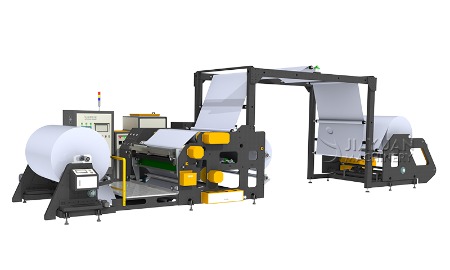
Adhesive coating machine
Industry 4.0 integration is transforming PSA tape production into a smart factory. The coating line is equipped with a network of sensors that collect data on every aspect of the process: temperature, pressure, speed, tension, coat weight, viscosity, and environmental conditions. This data is transmitted to a cloud-based platform where it is aggregated and analyzed. Machine learning models are used for predictive quality: they predict the peel adhesion or shear strength of the tape based on the process parameters, allowing the operator to adjust the settings before the tape is even tested. Digital twins—virtual replicas of the coating line—are used for off-line optimization; the operator can simulate the effect of changing a parameter (e.g., increasing the speed) on the quality without running a real trial, saving time and material. The digital twin can also be used for training operators. The data from multiple production lines is aggregated to identify best practices and to benchmark performance. The integration also enables remote monitoring and diagnostics; experts can troubleshoot issues from anywhere, reducing the response time. The Industry 4.0 approach leads to significant improvements in quality, yield, and energy efficiency. In summary, the future of PSA tape production lies in the full integration of digital technologies, enabling a self-optimizing production system that continuously learns and improves, delivering consistent, high-quality tapes with minimal waste and cost.
The implementation of these advanced technologies requires a skilled workforce. Operators must be trained to interpret the data, understand the control algorithms, and take appropriate actions. Engineers must be proficient in data analytics and control theory. The transition to a smart factory is a journey; it involves upgrading the hardware (sensors, actuators), the software (control systems, data platforms), and the people. Many manufacturers start with a pilot project on one line, demonstrate the benefits, and then scale up. The return on investment is substantial: reduced scrap, higher throughput, better quality, and lower maintenance costs. In conclusion, PSA tape production is at the forefront of industrial digitalization, and the adoption of advanced process control, inline inspection, predictive maintenance, and Industry 4.0 technologies is driving the industry towards higher efficiency, quality, and sustainability. This not only benefits the manufacturers but also the end-users, who receive more reliable and consistent products.