PSA Tape Production: From Adhesive Formulation to Finished Roll – A Comprehensive Overview
PSA tape production is a highly integrated manufacturing process that transforms raw materials—backing (substrate), adhesive, and release liner—into a finished tape roll ready for consumer or industrial use. The process begins with the adhesive formulation: a blend of base polymer (acrylic, rubber, or silicone), tackifiers, plasticizers, crosslinkers, and stabilizers is prepared in a mixing tank. The formulation must be tailored to the specific tape application: packaging tapes require high tack and peel, masking tapes need good heat resistance, and medical tapes demand hypoallergenic properties. The adhesive is then pumped to the coating line. The backing (e.g., BOPP, PET, paper, cloth) is unwound and often corona-treated to increase surface energy for better adhesion. The adhesive is applied to the backing using a coating head—slot-die, gravure, or roll—depending on the required coat weight and uniformity. The coated web then passes through a drying oven (for solvent/water-based adhesives) or a cooling section (for hot-melt adhesives). For solvent-based adhesives, the oven must remove solvents and also enable crosslinking; the drying profile is critical. For double-sided tapes, a release liner is laminated to the adhesive surface after drying; for transfer tapes, the adhesive is coated on the liner and later transferred. The finished web is then rewound into a large master roll. This master roll is sent to a slitting station where it is cut into narrower rolls of specified widths. The slit rolls are then packaged. Throughout the process, quality is monitored by inline gauges (coat weight, thickness) and off-line tests (peel, tack, shear). The entire production line is controlled by a centralized system that coordinates the drives, temperatures, and tensions. PSA tape production is a high-speed (up to 500 m/min), high-volume operation that demands precision and reliability.
The coating step is the heart of PSA tape production. The coat weight directly determines the tape's performance: a higher coat weight increases peel and tack but may reduce shear. Typical coat weights are 10-30 gsm for single-sided tapes and 20-50 gsm for double-sided. Slot-die coating is the preferred method for high-precision tapes because it delivers excellent uniformity (±1%) and is pre-metered, reducing waste. Gravure is used for thinner coatings (5-15 gsm) at high speeds, but it may leave a pattern. Roll coating is used for simpler, low-cost tapes. The coating head must be maintained precisely; the die gap or cell volume must be calibrated. The adhesive supply system includes a pump (gear or piston), a filter (to remove gels), and a degasser (to remove bubbles). The pump speed is set based on the target coat weight and line speed. The drying oven is often a multi-zone convection oven with impingement air; the temperature profile is critical. For solvent-based acrylics, a typical profile is: zone 1 at 60°C (to avoid skinning), zone 2 at 90°C, zone 3 at 120°C. The oven length is determined by the required residence time; for high-speed lines, the oven can be 30-50 meters long. For water-based adhesives, the oven must handle high humidity; the exhaust air must be dehumidified. For hot-melts, no oven is needed; instead, the adhesive is cooled by a chill roll. The cooling rate affects the adhesive's crystallinity and thus its tack. The coated web is then inspected for defects (streaks, pinholes) by a camera system. The web tension must be controlled to avoid stretching the backing, which would change the coat weight and cause wrinkles. In summary, the coating step is a complex interplay of fluid mechanics, heat transfer, and mechanical precision, and it is the key to producing consistent, high-quality PSA tapes.
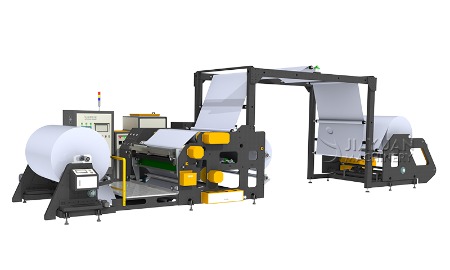
Adhesive coating machine
The lamination and winding steps are equally important, especially for double-sided and transfer tapes. For double-sided tapes, after the adhesive is coated and dried, a release liner is laminated to the adhesive surface. The liner is a siliconized paper or film that provides a protective layer and is removed by the end user. The laminating nip pressure must be controlled to avoid trapping air bubbles and to ensure good adhesion between the adhesive and the liner. For transfer tapes, the adhesive is coated on the liner and then laminated to the face stock in a separate step. The lamination process requires precise alignment of the two webs and uniform pressure. The winding (rewinding) of the finished web into master rolls must be done with controlled tension; too high a tension can cause blocking (the adhesive sticking to the backside of the backing), while too low a tension causes telescoping (layers shifting). Taper tension—gradually reducing tension as the roll diameter grows—is used to maintain a constant roll hardness. The rewinder is equipped with a lay-on roll to remove air and ensure a tight wind. The master rolls are then stored in a controlled environment (temperature, humidity) to prevent aging. The slitting step cuts the master roll into customer-specified widths; the slitter knives must be sharp and aligned to produce clean edges without burrs or fraying. The slit rolls are then packed and labeled. In summary, the lamination and winding steps are critical for the final product's appearance and convertibility, and they require careful control of pressure, tension, and alignment.
Quality control in
PSA tape production is comprehensive. The tape's performance is tested according to standardized methods: peel adhesion (180° or 90° peel from a standard panel), tack (rolling ball or loop tack), and shear (static or dynamic). The coat weight and thickness are measured; the thickness must be uniform. The tape's aging resistance is tested by heat and humidity aging; the peel and shear should not degrade significantly. The tape's color and clarity are checked for optical applications. The release force of the liner (for double-sided tapes) is measured; it must be consistent. The quality data is recorded and analyzed using SPC. If a test fails, the cause is investigated: a low peel may be due to low coat weight, under-curing, or contamination; a low shear may be due to over-plasticization or insufficient crosslinking. The corrective action is taken, and the process is adjusted. The quality management system ensures traceability and compliance with customer specifications. In conclusion, PSA tape production is a sophisticated manufacturing process that integrates chemistry, coating engineering, and converting. By optimizing each step—formulation, coating, drying, lamination, slitting, and quality control—manufacturers can produce a wide range of tapes that meet the diverse needs of the market, from simple packaging tapes to high-performance medical and optical tapes.