PSA coating machine
PSA (pressure sensitive adhesive) coating machines are precision-engineered industrial systems designed specifically for applying pressure-sensitive adhesives onto continuous webs of substrate material. These machines are the backbone of the self-adhesive product industry, enabling the production of labels, tapes, medical dressings, and protective films. This technical article explores the working principles, machine configurations, coating methods, and quality control aspects of PSA coating machines.
PSA coating machines operate on the principle of applying a thin, uniform layer of pressure-sensitive adhesive onto a substrate (either the final facestock or a release liner) in a continuous roll-to-roll process. The two principal coating techniques are direct coating, where adhesive is applied directly onto the facestock, and transfer coating, where adhesive is first applied to a release liner and later transferred to the final substrate. Transfer coating is preferred for most label applications because it allows the adhesive to be coated under optimal conditions on a stable liner before lamination to the face material. The machine configuration includes unwind stations, coating heads, drying or cooling sections, laminating stations, and rewind systems, all integrated with precise tension and temperature controls.
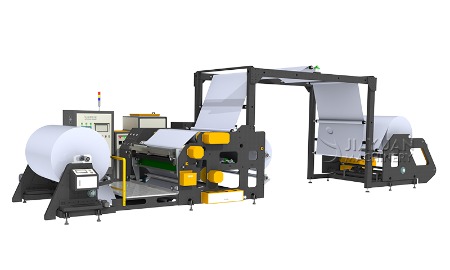
Adhesive coating machine
Slot die coating has emerged as the dominant technology for PSA coating due to its exceptional precision and ability to produce uniform coatings at high speeds. The slot die consists of a precision-machined block with an internal manifold (typically a coat-hanger design) that distributes molten or liquid adhesive uniformly across the full web width. The adhesive exits through a narrow slot formed by two lips, with the lip gap precisely adjustable to control coat weight. For hot melt PSAs, the die is heated to maintain the adhesive at the correct viscosity (typically 500-2000 mPa·s at 150-170°C for label PSAs). The coating bead between the die lip and substrate is a critical free surface flow that must be maintained within a stable operating window to prevent defects. Advanced dies incorporate thermal actuators for fine adjustment of the lip gap and can achieve thickness uniformity within ±1%.
The process control system is the brain of a PSA coating machine, managing all critical parameters to ensure consistent product quality. Coat weight is controlled by a closed-loop system where a beta or X-ray gauge measures the coated web and provides feedback to the gear pump drive, adjusting adhesive flow in real-time. Tension control is maintained through servo-driven motors and dancer rolls, ensuring consistent web handling across all machine sections. Temperature control is critical for hot melt PSAs, with precise regulation of the melt tank, hoses, and die to maintain the adhesive at the optimal application temperature. Modern PSA coating machines also include automatic die lip adjustment systems that can correct cross-web coat weight variations by locally adjusting the lip gap. These control systems are typically integrated through a PLC with an intuitive operator interface for monitoring and adjusting process parameters.
PSA coating machines find applications across a wide range of industries. In the packaging sector, they produce pressure-sensitive tapes for carton sealing, masking, double-sided bonding, and specialty applications. The label industry relies on PSA coating machines for manufacturing self-adhesive labels for consumer goods, logistics, and industrial identification. Medical applications include surgical tapes, wound dressings, transdermal patches, and medical device components requiring precise adhesive deposition. Other applications include protective films for electronics and automotive, graphic arts products, and specialty industrial materials. The growing demand for sustainable packaging and medical adhesive products continues to drive innovation in PSA coating technology, with manufacturers developing machines capable of processing bio-based adhesives, reducing energy consumption, and minimizing waste.