PSA tape production
PSA tape production is the industrial manufacturing process for pressure-sensitive adhesive tapes, which are among the most widely used adhesive products in packaging, automotive, medical, electrical, and consumer applications. The production process involves coating a pressure-sensitive adhesive onto a backing material (film, paper, cloth, or foam), followed by drying or cooling, and often slitting and converting into finished tape rolls. This article provides a comprehensive technical overview of PSA tape production, including raw materials, coating methods, process flow, quality control, and key applications.
The PSA tape production process begins with the selection of the backing material, which determines the tape's mechanical properties, temperature resistance, and conformability. Common backings include BOPP film (for packaging tapes), crepe paper (for masking tapes), PET film (for electrical and double-sided tapes), PVC film (for electrical insulation), cloth (for duct and gaffer tapes), and foam (for mounting tapes). The backing may be surface-treated (corona, flame, or primer coating) to improve adhesive anchorage. The pressure-sensitive adhesive is formulated from elastomers (natural rubber, SBC, acrylic, or silicone), tackifiers, plasticizers, and crosslinkers, and is applied as a hot melt, solvent-based, or water-based system. The choice of adhesive chemistry determines the tape's tack, peel adhesion, shear strength, and temperature resistance.
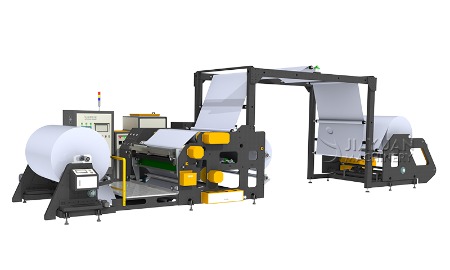
Adhesive coating machine
The coating process is the core of PSA tape production. The adhesive is applied onto the backing using methods such as slot die, comma blade, gravure, or roll coating. Slot die coating is the preferred method for hot melt PSAs due to its high precision (coat weight uniformity within ±1-2%) and high speed (up to 600 m/min). Comma blade coating is widely used for water-based and solvent-based adhesives on paper and cloth backings. The coat weight (GSM) is the primary control parameter, typically ranging from 15 to 50 gsm for most tapes, and is monitored by online beta or X-ray gauges with closed-loop feedback. For solvent-based and water-based adhesives, the coated web passes through a drying oven with multiple temperature zones to evaporate the carrier. For hot melt adhesives, the coated web passes over chill rolls (5-15°C) to rapidly solidify the adhesive. The line speed for PSA tape production ranges from 100 to 600 m/min, depending on the adhesive type and coating method.
After coating and drying/cooling, the tape may undergo additional processing steps. For double-sided tapes, a second adhesive coating is applied to the opposite side of the carrier, or a transfer coating method is used. For tapes with release liners (e.g., double-sided and some medical tapes), the liner is laminated to the adhesive side under pressure. The wide master roll is then slit into narrower tape rolls using precision slitting machines. The slitting operation requires sharp blades and precise tension control to produce clean edges without adhesive squeeze-out (stringing). The finished rolls are then packaged for shipment. Quality control in PSA tape production includes testing for peel adhesion (to standard substrates), tack (loop tack or probe tack), shear holding power (static shear), and aging resistance. The tape must also meet dimensional specifications (width, thickness, length) and visual quality standards (no streaks, pinholes, or contamination). Data logging of all process parameters ensures traceability and supports continuous improvement.
PSA tape production lines are complex, integrated systems that combine multiple unit operations. A typical hot melt tape coating line includes an unwind stand for the backing, a corona treater, a slot die coating head with melt tank and heated hoses, a chill roll cooling section, a laminating station (for liner application), a slitting station, and a turret rewind. The line is controlled by a PLC-based system that synchronizes all drives, tensions, and temperatures. Tension control is critical to prevent stretching of thin film backings; tension zones are individually controlled with load cell feedback. The line also includes edge guides to maintain web alignment, web cleaners to remove dust, and inspection systems for defect detection. The production line footprint for hot melt is compact (15-30 meters) because no drying oven is required, while solvent-based lines require long drying tunnels (30-60 meters) and solvent recovery systems. The capital cost of a hot melt line is typically lower than a solvent-based line, and operating costs are significantly reduced due to lower energy consumption and no solvent abatement.
PSA tape production serves a vast array of industries. Packaging tapes (BOPP) are produced on high-speed hot melt lines for carton sealing and bundling. Masking tapes use crepe paper with rubber-based PSAs for paint masking and surface protection. Double-sided tapes have adhesive on both sides for mounting, splicing, and foam attachment. Electrical tapes (PVC, PET) require flame-retardant adhesives and precise thickness control. Medical tapes (surgical, first-aid) use skin-friendly adhesives on breathable substrates, often produced in cleanroom environments. Automotive tapes include foam mounting tapes and acoustic tapes requiring high shear adhesion. The trend in PSA tape production is toward thinner, high-performance tapes, water-based and hot melt systems to reduce VOCs, and the use of bio-based and recyclable materials. Automation and Industry 4.0 technologies are being integrated to monitor and optimize production in real-time, improving yield and reducing waste.