Packaging Adhesive Coater: Systems for Flexible Packaging, Cartons, and Labels
Packaging adhesive coaters are integral to the production of packaging materials such as laminated films, cardboard boxes, corrugated containers, and pressure-sensitive labels. The adhesives used vary widely: hot-melt adhesives for high-speed carton sealing and case sealing; water-based adhesives for paper and film lamination; solvent-based adhesives for high-performance flexible packaging (though declining due to environmental concerns); and UV-curable adhesives for some specialty labels. The coating machine must apply the adhesive uniformly at the required coat weight, typically 2-30 gsm, depending on the application. For flexible packaging (e.g., food pouches), the adhesive is applied to a film and then laminated to another film or foil. This requires a precision coating method like slot-die or gravure to ensure a uniform adhesive layer with no defects. The coat weight for laminating adhesives is usually 3-10 gsm. For carton sealing, the adhesive is applied as a bead or spray pattern onto the flap; coat weights are 5-15 gsm. For labels, the adhesive is coated on a release liner or directly on the face stock; coat weights are 10-25 gsm. The packaging adhesive coater is often integrated into a converting line with unwinders, laminators, slitters, and rewinders. The line speed can be up to 500 m/min. The machine must handle a wide range of substrates—paper, board, plastic films, aluminum foil—and must be easy to clean for quick changeovers between products.
Hot-melt adhesive coating is dominant in packaging due to its solvent-free nature, fast setting, and high adhesion to various substrates. The adhesive is melted in a tank and pumped through heated hoses to the coating head. The coating head can be a slot-die (for film laminating), a roll coater (for high coat weight applications), or a spray nozzle (for carton sealing). Hot-melt coaters require precise temperature control (±1°C) because viscosity changes with temperature. The melt temperature is typically 120-180°C. The adhesive must be applied at a temperature high enough to wet the substrate but not so high as to degrade the polymer. For water-based adhesives, the coating line includes a drying oven to evaporate the water. Water-based coaters are used for paper laminating and for applications where low odor is required. They are more energy-intensive due to drying but safer to handle. Solvent-based adhesives are used for high-barrier laminations (e.g., for retort pouches) where heat resistance is needed. They require solvent recovery systems and explosion-proof equipment. The choice of adhesive and coater type depends on the packaging application, the substrate, the required bond strength, and the production speed. Cost and environmental regulations also influence the decision. The
packaging adhesive coater must be designed for easy maintenance; the coating head should be accessible for cleaning and die changes. The control system should store recipes and provide diagnostics to minimize downtime.
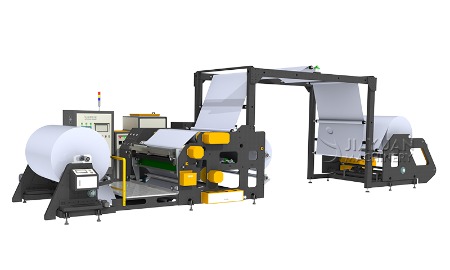
Adhesive coating machine
Process optimization for packaging adhesive coating focuses on coat weight uniformity, adhesion strength, and defect prevention. The coat weight is monitored by a beta or X-ray gauge; the control system adjusts the pump speed or the die gap to maintain the target. For hot-melt systems, the temperature profile is critical; sensors at the die and the hose monitor the temperature, and the control system adjusts the heaters. The substrate's surface energy must be adequate; corona treatment is often used for films. The nip pressure for lamination must be controlled to ensure good contact without squeezing out the adhesive. The adhesive's open time (the time before it sets) must be matched to the line speed; if the speed is too high, the adhesive may not have time to wet the substrate. The drying/cooling section must be sized correctly: for hot-melt, a chill roll or cooling tunnel is used; for water-based, a long oven with impingement air is needed. The machine's tension control must be stable to prevent wrinkles. The operator can use a design of experiments to find the optimal combination of temperature, pressure, and speed for each product. The optimization also includes minimizing adhesive waste; using a pre-metered system like slot-die reduces waste compared to roll coating. In addition, the use of low-temperature hot-melts can save energy and reduce substrate heating. Regular maintenance of the pumps, filters, and coating heads is essential to maintain quality. In summary, packaging adhesive coaters are versatile systems that require careful selection and optimization to meet the demanding requirements of modern packaging, including speed, reliability, and sustainability.