Paper Coating: Defect Troubleshooting, Quality Control, and Sustainable Coatings
Defects in paper coating can ruin the paper's printability and appearance. Streaks are linear defects caused by a damaged blade, worn roll, or uneven coating flow; inspecting and replacing the blade, cleaning the roll, and adjusting the flow solve this. Mottling is a localized unevenness in gloss or pick resistance, often due to poor coating formulation or drying non-uniformity; adjusting the binder level and improving the drying profile helps. Pickout (the coating pulling off during printing) is caused by low surface strength; increasing the binder content or reducing the coating weight prevents it. Blistering is the formation of bubbles under the coating due to trapped air or water; reducing the drying temperature gradient and using a slower initial drying rate prevent it. Edge bead causes thick edges; it is managed by blade edge taper or by trimming the edges. Back transfer (coating transferring to the back side of the paper) is caused by excessive coating viscosity or high temperature; reducing the viscosity or lowering the temperature corrects it. A systematic troubleshooting process: define the defect, inspect the coating head and the paper surface, check the process parameters, test the coating color's viscosity and solids, and verify the drying profile. The corrective action is documented. Preventive maintenance includes regular blade changes, roll cleaning, and sensor calibration. Operators should be trained to identify defects early and adjust the parameters. In-line inspection systems (cameras, gauges) can detect defects and reject defective sections automatically, improving quality and reducing waste.
Quality control for coated paper involves a range of tests. The coat weight is measured online and verified by weighing samples. The gloss is measured by a gloss meter at a specified angle (e.g., 75°). The brightness and opacity are measured by a spectrophotometer. The smoothness is measured by the Bekk or Parker Print Surf tester. The pick resistance is measured by a wax pick or IGT printability tester. The porosity is measured by an air permeability tester. For packaging papers, the barrier properties (moisture and grease resistance) are tested. The quality data is recorded and analyzed using SPC. If a test fails, the process is investigated; the cause may be a change in the coating color's composition, a drift in the blade pressure, or a variation in the paper's surface. The corrective action is implemented and verified. The quality management system must comply with ISO 9001 and, for food contact, with FDA regulations. The traceability of the coating components and the paper is maintained. In summary, rigorous quality control ensures that the coated paper meets the requirements of printers and converters, providing the basis for high-quality printed products.
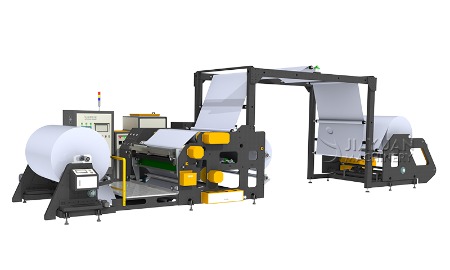
Adhesive coating machine
Sustainability is a growing focus in
paper coating. Bio-based binders, such as modified starches and biopolymers, are replacing petroleum-based latex to reduce the carbon footprint. These binders must provide comparable strength and printability. Recycled pigments from waste paper and calcium carbonate from industrial by-products are being used to reduce the consumption of virgin materials. The coating machine must be adapted to handle these new materials; for example, bio-based binders may have different rheology, requiring adjusted coating settings. The trend towards lighter paper (decreasing basis weight) requires thinner coatings with higher pigment content; this challenges the coating process to achieve uniform coverage at lower coat weights. The development of barrier coatings for paper to replace plastic laminates is a major driver; these coatings must provide oil and grease resistance while being recyclable. The coating line must be able to apply these functional coatings with precision. The use of renewable energy for drying and the recovery of heat from the oven exhaust reduce the environmental impact. In conclusion, paper coating is evolving towards more sustainable practices, with new materials and processes that maintain or improve paper quality while reducing the environmental footprint.