Paper Coating: Processes for Printing, Packaging, and Specialty Papers
Paper coating is a widely used process in the paper industry to enhance the paper's surface for printing, packaging, and specialty applications. Coated paper has improved gloss, smoothness, and ink holdout, resulting in high-quality printing. It is used for magazines, catalogs, packaging boxes, and labels. The coating mixture, or "coating color," is a water-based slurry consisting of pigments (clay, calcium carbonate, titanium dioxide), binders (latex, starch), and additives (dispersants, thickeners, lubricants). The coating solids content is typically 50-70%. The coat weight varies from 5 to 30 gsm per side; for double-coated papers, two layers are applied. The coating process must be uniform to avoid streaks and mottling. The main coating methods are blade coating, roll coating, curtain coating, and slot-die coating. Blade coating is the most common; a flexible blade (steel) meters the coating onto the paper surface. Roll coating uses a series of rolls to transfer the coating; it is used for high coat weights. Curtain coating is a non-contact method where the coating falls as a free liquid curtain; it is used for high-speed, wide-web coating. Slot-die coating is gaining popularity for its precision and waste reduction, especially for specialty papers. The coating machine is typically integrated into the paper machine or operated off-line. The line speed is typically 500-1500 m/min, making it one of the fastest coating processes. The coating line includes an unwinder, the coating head, a drying section (air impingement or IR), and a rewinder. The drying section is usually a series of steam-heated cylinders and hot air hoods. The coated paper is then calendered (pressed between rolls) to increase gloss and smoothness.
The coating formulation is critical to the paper's final properties. Pigments provide the optical properties (brightness, opacity) and surface structure. Binders hold the pigments together and adhere them to the paper; latex is the most common. Additives control the rheology, water retention, and runnability of the coating color. The viscosity must be stable; too high viscosity causes poor leveling; too low causes run-off. The coating color is prepared in a mixing tank and pumped through a screen to remove impurities. For blade coating, the blade angle and pressure control the coat weight; the blade must be uniform to avoid streaks. For roll coating, the gap between the rolls controls the coating weight. For curtain coating, the flow rate and web speed determine the coat weight; the curtain must be stable and free of air bubbles. The drying section must evaporate the water quickly; the temperature is typically 100-150°C. The drying rate is a limiting factor for line speed. The coated paper is often calendered after drying to achieve the required smoothness and gloss. The calender is a set of hard and soft rolls that apply pressure and heat. The machine's control system monitors coat weight, moisture content, and gloss. The coat weight is measured by an X-ray or infrared gauge; the gauge feedback adjusts the blade pressure or pump flow. The moisture content is monitored by an NIR gauge; the drying temperature is adjusted to maintain the target. The quality of the coated paper is tested for brightness, gloss, smoothness (Bekk or Parker Print Surf), and porosity. The coating must have good pick resistance for printing. In summary,
paper coating is a high-speed, high-volume process that requires precise control of the coating formulation, application, and drying to produce the desired surface properties for printing and packaging.
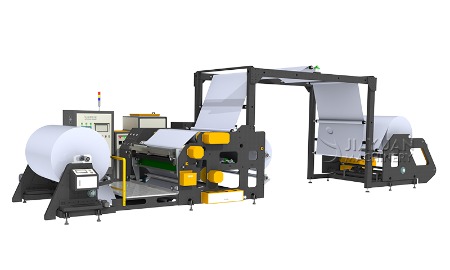
Adhesive coating machine
Process optimization for paper coating focuses on maximizing speed, minimizing waste, and achieving uniform quality. The blade coating process is optimized by adjusting the blade load, the coating color's solids content, and the speed. A higher blade load gives a lower coat weight but may cause blade wear. The solids content affects the viscosity; higher solids reduce drying load but may cause poor flow. The speed is limited by the drying capacity; the oven must evaporate the water at the required rate. The use of air impingement drying and infrared pre-heaters can increase the drying rate. The waste (trim and off-spec) is minimized by precise edge control and by using a diverting valve for startup. The calendering pressure and temperature are optimized to achieve the target gloss without reducing the paper's strength. The optimization is done through a design of experiments; the results are used to set the operating point. The machine's control system uses model predictive control to adjust the parameters based on the quality data. The operators are trained to interpret the quality data and make adjustments. In summary, process optimization improves the efficiency and product quality of paper coating, reducing costs and increasing competitiveness.