Pattern Coating: Advanced Registration, Multi-Layer Patterns, and Quality Inspection
Registration is the alignment of the pattern to the substrate's features or to other patterns. For example, a conductive pattern must be aligned to the contact pads on a flexible circuit; a decorative pattern must be aligned to the printed graphics. Registration is achieved by using a registration mark on the substrate (printed or pre-applied) and a registration sensor (camera or photoelectric) that detects the mark. The control system adjusts the pattern's position by shifting the start time of the coating (for intermittent or inkjet) or by steering the web. For rotary screen or gravure, the cylinder's angular position is adjusted using a servo motor. The registration accuracy must be within the required tolerance, typically ±0.1-1 mm. For high-precision electronics, the tolerance can be as tight as ±20 µm. The registration system must be robust to variations in the substrate's stretch and the web speed. In summary, accurate registration is essential for functional and decorative patterns.
Multi-layer pattern coating is used when multiple functional layers with different patterns are required. For example, a battery electrode may have a primary active pattern and a secondary insulating pattern; a sensor may have multiple conductive and dielectric patterns. The challenge is to register the patterns to each other with high accuracy. This is done by using a common registration mark, or by using a "print-and-register" system where the first pattern's position is detected and used to position the subsequent patterns. The coating heads are arranged sequentially, and each head has its own registration sensor. The control system coordinates the heads. The drying/curing between layers must be optimized to prevent the first layer from moving or being dissolved by the second layer. The layer thickness and the pattern dimensions must be compatible. Multi-layer
pattern coating is a complex but powerful technique for creating highly functional, integrated products. In summary, multi-layer pattern coating enables the production of advanced, multi-functional coated products.
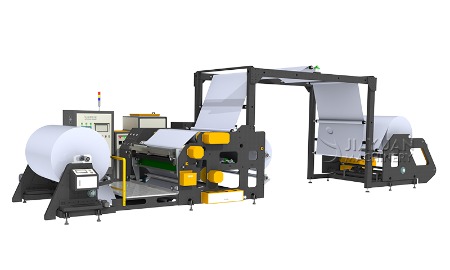
Adhesive coating machine
Inline inspection is critical for quality assurance in pattern coating. A line-scan camera with appropriate lighting captures images of the pattern; the images are processed by software that detects defects: missing elements, extra spots, misregistration, blurred edges, and variations in line width. The defect data is used to generate a defect map and to trigger alerts. The inspection system can also provide feedback to the control system: if the registration drifts, the system adjusts the timing; if the pattern width changes, the system adjusts the coating parameters. The inspection system's resolution must be sufficient to detect defects at the required size; for electronics, a camera with a pixel size of 5-10 µm is needed. The system should be calibrated regularly and should be validated with known defects. In summary, inline inspection ensures that pattern coating quality is maintained and that defective products are identified and rejected.
Defect prevention in pattern coating involves regular maintenance of the pattern-forming elements: cleaning the screens, checking the gravure cylinders for wear, and validating the inkjet nozzles. The fluid's filter must be effective to prevent nozzle or screen clogging. The substrate's cleanliness is important; dust can cause defects. The environmental conditions (temperature, humidity) should be controlled to prevent variations in the fluid's properties. The operator should use a checklist to inspect the pattern before and during the run. In summary, a proactive approach to defect prevention reduces the need for reactive inspection and rework.
Practical implementation: (1) Design patterns with a registration mark that is distinct and robust. (2) Use a high-resolution camera for registration and inspection. (3) Implement a closed-loop registration control that adjusts the pattern's position in real-time. (4) For multi-layer patterns, use a common registration mark and coordinate the heads. (5) Use a defect classification system to prioritize the most critical defects. (6) Train operators on pattern inspection and correction procedures. (7) Document the pattern parameters and the registration data for each product. In conclusion, advanced registration, multi-layer capability, and inline inspection are the pillars of high-quality pattern coating. By mastering these aspects, manufacturers can produce complex, precision-patterned coatings that meet the stringent requirements of the electronics, medical, and automotive industries, opening up new product possibilities and competitive advantages.