Pattern Coating: Technologies, Design, and Process Control for Functional and Decorative Patterns
Pattern coating is used to apply coatings in specific shapes, lines, dots, grids, or other geometries, leaving the rest of the substrate uncoated. This technique is employed for decorative effects (e.g., colored patterns on packaging), functional applications (e.g., conductive tracks in flexible electronics, adhesive grids for bonding, or barrier stripes for controlled release), and for controlled deposition of active materials (e.g., in biosensors). The pattern dimensions can range from a few micrometers (for electronics) to several centimeters (for decorative patterns). The coating thickness within the pattern must be uniform, and the edges must be sharp—with minimal bleeding, spreading, or saw-tooth effects. The choice of pattern coating technology depends on the required resolution, the coating fluid's viscosity, the production speed, and the cost. Rotary screen printing can produce patterns with a resolution of 50-200 µm, using a mesh screen with a patterned stencil; the fluid is forced through the screen by a squeegee. Gravure with engraved cells can create fine lines and dots; the pattern is defined by the engraving. Flexographic printing uses a relief plate; it is suitable for simple patterns and higher speeds. Slot-die with a patterned shim restricts the flow to certain lanes; it can create continuous stripes or interrupted patterns. Digital inkjet offers maximum flexibility; the pattern is defined by software and can be changed instantly. In summary, the selection of the pattern coating technology is a trade-off between resolution, speed, flexibility, and cost.
The pattern design must consider the fluid's surface tension and the substrate's surface energy. The fluid tends to spread (or de-wet) after deposition, which can blur the pattern. To maintain sharp edges, the fluid's surface tension should be high relative to the substrate's surface energy, or the pattern should be designed with a small margin. The pattern definition—the ratio of the coated area to the total area—affects the drying behavior; a pattern with isolated islands may dry faster than a continuous film, causing differential stresses. The pattern should also be designed to avoid sharp corners, which can lead to stress concentration. For functional patterns, the line width and spacing must be within the required tolerance. The pattern design is typically created in a CAD software and then converted into the format required by the coating technology (e.g., a screen stencil, an engraved cylinder, or a digital file). In summary, a well-designed pattern balances aesthetic or functional requirements with the physical limitations of the coating process.
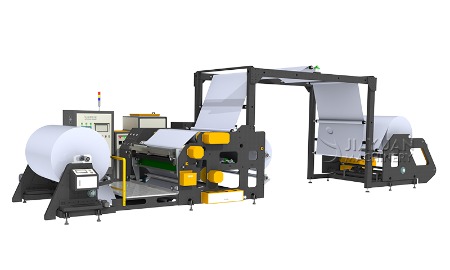
Adhesive coating machine
Process control for
pattern coating involves maintaining the pattern's dimensions (width, length, spacing) and the coat weight within the pattern. The coat weight within the pattern is determined by the same parameters as in full-width coating: the fluid flow rate, the line speed, and the solids content. However, pattern coating often has a lower flow rate because the fluid is only applied in the patterned areas; the pump speed must be adjusted accordingly. The pattern's dimensions are controlled by the mechanical registration (for rotary screen, gravure, flexo) or by the software (for inkjet). The registration must be maintained over time; any drift causes the pattern to shift. The edge definition is affected by the fluid's rheology; shear-thinning fluids may spread less after deposition. The drying/curing process must be matched to the pattern; the uncoated areas may cause a different heat transfer, leading to temperature gradients. The operator should monitor the pattern using a camera system and adjust the parameters to correct any drift. In summary, pattern coating requires precise control of both the coat weight and the pattern geometry.
Digital inkjet coating is an increasingly popular pattern coating method, especially for short runs and variable patterns. Inkjet heads deposit droplets of fluid in a controlled pattern, with a resolution of up to 1200 dpi. The fluid viscosity must be low (typically 5-20 cP) and the surface tension must be suitable for droplet formation. The droplet size determines the minimum line width; for 10 picoliter droplets, the line width can be 20-50 µm. The pattern is defined by a digital file, and the printhead is moved across the substrate or the substrate moves under the printhead. The printhead must be cleaned regularly to prevent nozzle clogging. Inkjet coating offers the ultimate flexibility but is slower than continuous methods (typically <100 m/min) and has higher operating costs. It is used for prototyping, for small batch production, and for applications requiring frequent pattern changes. In summary, digital inkjet is a versatile pattern coating technology with high resolution and flexibility.
Troubleshooting pattern coating: (1) Blurred edges: reduce the fluid's viscosity, increase the substrate's surface energy, or increase the drying rate. (2) Missing pattern elements: check the screen, the engraving, or the printhead for blockages. (3) Pattern drift: check the registration system and the web's tracking. (4) Variable coat weight within the pattern: check the pump stability and the die gap. (5) Bleeding (fluid spreading beyond the pattern): reduce the fluid's wetting ability or add a surfactant. A systematic approach using a camera and a thickness gauge is effective. In conclusion, pattern coating is a valuable technique for creating functional and decorative coatings with precision. By selecting the appropriate technology, designing the pattern carefully, and controlling the process parameters, manufacturers can produce high-quality patterned coatings for a wide range of applications, from electronics to packaging and medical devices.