Precision Adhesive Coating Machine: Design Principles and Process Control
Adhesive coating machines are specialized industrial systems designed to apply uniform layers of adhesives onto various flexible or rigid substrates. These machines are fundamental in producing tapes, labels, films, foams, and composite materials. The core challenge in adhesive coating lies in achieving consistent coat weight, controlled wetting, and defect-free surfaces while handling fluids with widely varying rheological properties—from low-viscosity emulsions to high-viscosity hot melts. Modern machines integrate precision metering pumps, advanced drying or curing ovens, and tension control systems to meet stringent quality standards. The selection of coating method depends on the adhesive type, substrate characteristics, production speed, and target thickness.
The most common coating techniques used in adhesive coating machines are roll coating, gravure coating, slot-die coating, and curtain coating. Roll coating is versatile and economical for simple PSA and laminating adhesives, using a series of applicator and metering rolls to transfer fluid. Gravure coating uses an engraved cylinder to pick up and deposit precise micro-patterns, ideal for low-viscosity adhesives. Slot-die coating, however, has gained prominence for its pre-metered, closed-system operation that ensures exceptional thickness uniformity and minimal waste. It works by extruding adhesive through a precision slit directly onto the substrate, with the gap and flow rate precisely controlled. Each method demands specific mechanical configurations, such as doctor blades, backup rolls, and nip pressure adjustments, to regulate the final coat weight.
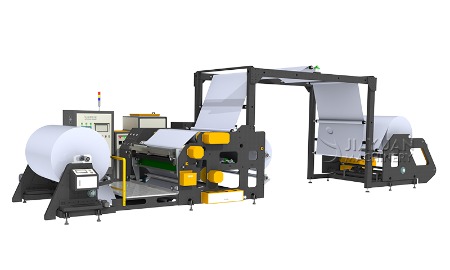
Adhesive coating machine
Critical to the performance of any adhesive coating machine is the fluid delivery system. This typically includes a tank with heating or stirring capabilities, a positive-displacement pump (gear, piston, or peristaltic), and filtration units to remove gels or agglomerates. Pump selection is vital: gear pumps provide pulse-free flow for high-viscosity adhesives, while diaphragm pumps are preferred for shear-sensitive emulsions. The supply line must be jacketed for hot-melt adhesives to maintain temperature and avoid crystallization. Pressure sensors and flow meters are integrated to provide real-time feedback to the control system, enabling automatic adjustments to compensate for viscosity drift or filter clogging. Without a stable delivery system, even the best coating head will produce streaks or thickness variations.
Drying and curing sections are equally important, especially for solvent-based or water-based adhesives that require evaporation of carriers. Convection ovens with multiple temperature zones and impingement air nozzles are common for solvent-based systems, while IR or UV units are used for reactive adhesives that cure via crosslinking. The drying profile must be carefully designed to avoid skin formation, blistering, or incomplete solvent removal, which could weaken bond strength. For hot-melt adhesives, cooling rolls or chill drums solidify the coating quickly without drying. Proper exhaust and solvent recovery systems are mandatory for safety and environmental compliance, particularly when handling volatile organic compounds. Energy efficiency is a growing concern, leading to the use of heat recovery wheels and optimized airflow designs.
Tension control and web handling are often overlooked but are crucial for maintaining register and preventing wrinkling or stretching. Adhesive coating lines run at speeds from 10 to over 500 m/min, and the web tension must be consistent from unwinding to rewinding. Closed-loop tension sensors, dancer rolls, and load cells work together to adjust the torque of driven rollers. Edge-guiding systems keep the web centered, while splicing tables allow continuous operation. In addition, the coating head must be precisely positioned relative to the web, with micrometer adjustments for die-to-web gap or roll nip pressure. Any misalignment introduces cross-web non-uniformity, which manifests as thick edges or thin centers. Regular calibration of these mechanical alignments is essential for reproducible quality.
Modern
adhesive coating machines incorporate Industry 4.0 features such as remote monitoring, predictive maintenance algorithms, and recipe management. Operators can access real-time dashboards showing coat weight, oven temperature profiles, and tension readings. Automated profile control systems use actuator arrays across the die width to dynamically adjust local flow and correct edge beads. Predictive analytics analyze vibration and temperature trends to forecast bearing failures or pump wear, scheduling maintenance before breakdown occurs. This digital transformation reduces waste, improves first-pass yield, and shortens changeover times between different adhesive grades. Overall, an adhesive coating machine is a sophisticated synergy of fluid mechanics, thermal engineering, and mechatronics, requiring holistic design and vigilant operation to produce high-performance adhesive products consistently.