Precision Coating: Advanced Metrology, Active Profile Control, and Real-Time Optimization
The accuracy of precision coating is fundamentally limited by the measurement system. Traditional beta gauges have a resolution of about ±0.1 gsm, which is sufficient for coatings >10 gsm, but for sub-micron optical coatings (e.g., 0.5 µm), a more precise method is needed. Optical interferometry uses the interference of light to measure the thickness of transparent or semi-transparent coatings with sub-nanometer resolution. Confocal sensors measure the distance to the coating surface with an accuracy of ±0.1 µm. These sensors are non-contact and can be mounted on a scanning frame to provide a high-resolution profile. For conductive coatings, eddy current or capacitive sensors can measure the thickness. The choice of sensor depends on the coating's material and the required resolution. The sensor data is used not only for control but also for process analysis; by examining the profile's frequency components, the operator can identify the source of periodic variations (e.g., roll eccentricity or pump pulsation). In summary, advanced metrology is the foundation of precision coating; without accurate measurement, precise control is impossible.
Active profile control is the key technology for correcting thickness variations across the width. In slot-die coating, thermal actuators (heater cartridges) are embedded in the die body near the lip. Each actuator controls a small zone (e.g., 20 mm wide). By heating a zone, the metal expands, reducing the gap and thus the coat weight locally; cooling contracts the gap, increasing the coat weight. The control system receives the profile from the scanning gauge and calculates the power required for each heater to flatten the profile. The response time is 5-30 seconds, which is sufficient for correcting slow drifts (thermal changes, die wear). For faster corrections, piezoelectric actuators are used; they respond in milliseconds and are used to correct roll runout or web thickness variations. Some advanced dies combine both: thermal actuators for the baseline and piezoelectric actuators for the high-frequency components. The active profile control can reduce the thickness variation from ±2% to ±0.5%, significantly improving yield. In summary, active profile control is a powerful tool that enables ultra-uniform coatings.
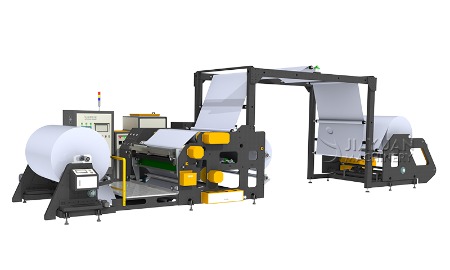
Adhesive coating machine
Real-time optimization using machine learning is emerging as a game-changer for
precision coating. The coating line generates a vast amount of data: speeds, temperatures, pressures, gaps, gauge readings, and defect counts. Machine learning algorithms (e.g., neural networks, random forests) can be trained on this data to predict the coat weight or the defect rate based on the current process parameters. The model can then be used in a "digital twin" simulation to find the optimal set of parameters for a given target. For example, if the target coat weight changes, the model can recommend the new pump speed and gap setting to achieve it with minimal transition waste. The model can also detect anomalies: if the actual coat weight differs from the predicted value by more than a threshold, it indicates a fault (e.g., a clogged filter or a worn seal). This predictive capability allows the operator to intervene before a defect occurs. In summary, machine learning transforms precision coating from a reactive process to a proactive, self-optimizing system.
Practical implementation of advanced metrology and control: (1) Select the appropriate thickness sensor for the coating's material and thickness range; (2) Install a scanning gauge with a high enough resolution to detect the required variations; (3) Integrate the gauge with the active profile control system; (4) Calibrate the thermal or piezoelectric actuators and verify their response; (5) Collect historical data from the line; (6) Train a machine learning model using the data; (7) Deploy the model in a real-time advisory system or in a closed-loop control; (8) Continuously update the model with new data to adapt to changes. The buyer should work with the machine supplier and the sensor manufacturer to implement these technologies. In conclusion, precision coating is advancing rapidly with the integration of high-resolution metrology, active profile control, and machine learning. These technologies enable manufacturers to push the boundaries of accuracy, achieving thickness variations of less than 0.5% and opening up new applications in high-tech industries. The investment in these advanced systems is justified by the increased yield, reduced waste, and the ability to produce high-value products that command premium prices.