Precision Coating: Principles, Equipment, and Process Control for High-Accuracy Thin Films
Precision coating is a manufacturing discipline that demands exceptional control over the coating thickness, uniformity, and defect density. Unlike general-purpose coating, where a ±5-10% variation is acceptable, precision coating targets tolerances of ±1% or better, often with coat weights as low as 1-10 gsm and thicknesses in the sub-micron to 50-micron range. This level of accuracy is essential for high-value products: optical films require nanometer-level uniformity to avoid color shifts; battery electrodes need precise active material loading to ensure cell capacity and safety; medical coatings must have consistent drug dosage or lubricity. The fundamental challenge is to eliminate all sources of variability: mechanical (roll runout, die deflection), fluid (viscosity, surface tension), and process (speed, temperature). The coating head must be manufactured with extreme precision—slot-die lips are ground to within 0.5 µm flatness, and gravure cylinders are engraved with cell depth tolerances of ±1 µm. The control system must have high-resolution encoders and fast-response actuators to maintain the setpoints. In summary, precision coating is the intersection of precision mechanics, fluid dynamics, and advanced control engineering.
The most common method for precision coating is slot-die coating, which is pre-metered and provides outstanding uniformity. The die gap and the pump flow rate directly set the wet thickness, independent of fluid properties (within a range). The die is designed with a manifold that ensures uniform flow distribution across the width; the shim defines the slot gap with an accuracy of ±2 µm. The die is mounted on a precision carriage that allows the die-to-web gap to be set and adjusted with micrometer screws. The web is supported by a precision backup roll with low runout (<5 µm). The pump is a servo-driven gear pump with a pulse dampener to eliminate flow ripples. The coating bead is stabilized by a vacuum box that maintains a controlled negative pressure. The entire system is housed in a cleanroom environment to prevent particle contamination. For very thin coatings (<2 µm), the die gap may be <0.1 mm, and the web speed must be precisely controlled to avoid air entrainment. In summary, slot-die coating is the workhorse of
precision coating due to its inherent accuracy and stability.
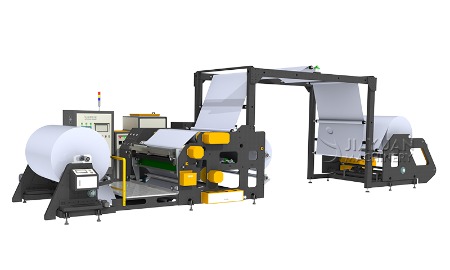
Adhesive coating machine
Gravure coating is also used for precision applications, especially for very thin layers (0.5-5 gsm). The engraved cylinder's cell volume determines the coat weight; the cells are engraved with a tolerance of ±1%. The doctor blade removes excess fluid; the blade pressure and angle must be precisely controlled. The impression roll pressure affects the transfer efficiency; any variation causes thickness changes. Gravure is faster than slot-die but may have a pattern that is visible in transparent coatings. Reverse-roll coating, where the applicator roll rotates opposite to the web, provides high shear and good leveling, and is used for medium-precision applications. The choice of method depends on the required thickness, speed, and the fluid's rheology. In summary, each method has its strengths; slot-die is the most precise, followed by gravure and reverse-roll.
Process control in precision coating involves multiple feedback loops. The primary loop controls the coat weight: a thickness gauge (beta, X-ray, or optical) measures the weight and adjusts the pump speed or the die gap. The secondary loop controls the temperature of the fluid and the die, as viscosity changes with temperature. The tension loop ensures stable web speed; any speed variation causes thickness changes. The gap control loop maintains the die-to-web gap, compensating for thermal expansion. The control system uses model predictive control (MPC) to anticipate disturbances, such as speed changes, and to adjust the parameters proactively. The operator interfaces with a high-resolution HMI that displays the thickness profile, the trends, and the alarms. The system also logs all data for traceability and for statistical process control (SPC). In summary, precision coating is a closed-loop system that continuously corrects for deviations.
Quality assurance for precision coating is rigorous. The thickness profile is measured continuously by a scanning gauge; the profile must be flat within the tolerance. The edge bead is measured and controlled. The coating's optical properties (haze, clarity) are measured for optical films; the electrical properties (resistance, capacitance) are measured for battery electrodes. The coating's adhesion and mechanical properties are tested off-line. The process capability (Cpk) is calculated; a Cpk > 1.67 is typically required. If the Cpk is lower, the process is improved by reducing the variability (e.g., by upgrading the gauge or the control system). In conclusion, precision coating is a sophisticated, data-driven process that combines advanced hardware, precise control, and stringent quality assurance. By mastering these elements, manufacturers can produce high-performance coatings for the most demanding applications, from displays to medical devices, achieving consistent quality and high yields.