Pressure Sensitive Adhesive Coating Machines: Core Components and Process Optimization
Pressure sensitive adhesive (PSA) coating machines are specifically designed to produce tapes, labels, and films that adhere upon application of light pressure. Unlike structural adhesives, PSAs are permanently tacky at room temperature and require no activation. The coating process for PSAs demands precise thickness control, typically 10 to 50 microns, to ensure consistent peel adhesion, tack, and shear strength. Most PSA coating lines run on either direct coating (applying adhesive directly onto the final substrate) or transfer coating (applying on a release liner and then laminating to the face stock). Transfer coating is preferred for delicate substrates like foams or thin films, as it avoids direct stress on the material. The machine layout includes an unwinder, corona treater (optional), coating head, drying oven (for solvent/water-based PSAs) or cooling zone (for hot-melt PSAs), and a rewinder with a laminating station for transfer coating. The precision of each component dictates the final product's performance.
The coating head is the heart of a PSA machine. For high-performance acrylic PSAs, slot-die coating has become the gold standard due to its pre-metered nature, which ensures coat weight accuracy within ±1%. It also reduces exposure to solvents, improving worker safety. For rubber-based hot-melt PSAs, roll coaters or extrusion dies are common, as they can handle high viscosity and high solids content. The pump feeding the slot die must be pulse-free; gear pumps with servo drives are typical. In gravure coating, often used for silicone release layers (which are sometimes coated on the liner before PSA application), the engraved cylinder and doctor blade must be meticulously maintained to avoid chatter marks. The coating head is mounted on a precision traverse mechanism that allows quick die change and gap adjustment. Many modern PSA coaters include automatic die gap mapping using linear actuators, which correct for thermal expansion and mechanical wear, maintaining uniformity across the full web width.
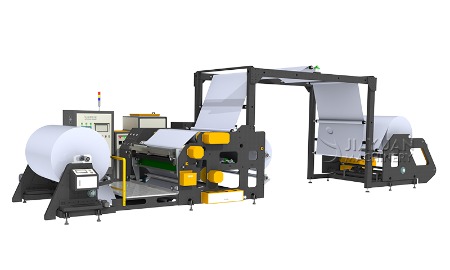
Adhesive coating machine
Drying or cooling is particularly critical for PSAs. Solvent-based acrylic PSAs require multi-zone ovens with staged temperature profiles—starting at moderate temperature to avoid skinning, then increasing to drive out solvent, and finally moderate to ensure complete evaporation. The oven length is often 20-40 meters for lines running at 100-200 m/min. Air impingement velocity and exhaust airflow must be balanced to prevent solvent condensation. For water-based PSAs, ovens must handle high humidity; moisture removal capacity is the bottleneck. Hot-melt PSAs, on the other hand, are applied molten and solidify upon cooling; thus, a chill roll or water-cooled drum is placed immediately after the coating head. Proper cooling rate affects crystallinity and thus tack. In all cases, the web temperature must be monitored to avoid substrate distortion. Modern ovens incorporate zoning with independent PID controllers and solvent concentration sensors for safety and efficiency.
After drying/cooling, the coated web may undergo lamination—pressing a release liner onto the adhesive surface for transfer-coated products, or applying a protective film for direct-coated products. Lamination nip pressure and roll temperature are critical; too low pressure leads to air entrapment, too high may squeeze out adhesive. Rubber-covered nip rolls with precise hardness (Shore A 60-80) are used. The rewinder then winds the finished roll with controlled tension, often using a turret rewinder for non-stop operation. To prevent blocking (adhesive sticking to the backing in the roll), a release liner or low-adhesion backside coating is needed for double-sided tapes. The entire line is overseen by a supervisory control system that logs data for each batch, enabling traceability and quality analysis.
Process optimization for PSA coating involves balancing speed, coat weight, and adhesive properties. Increasing speed reduces drying time, so higher temperatures or longer ovens are needed. However, excessive heat can degrade the adhesive (e.g., oxidation of rubber) or shrink the substrate. Pilot trials are essential to find the optimum. Moreover, the adhesive viscosity must be stable; temperature control of the supply tank and die is crucial. Routine viscosity checks with a rotational viscometer and adjustment with solvents or thickeners are part of daily QA. For hot-melt systems, the melt tank temperature and residence time must be controlled to prevent thermal degradation. Also, the coating gap or pump speed must be recalibrated whenever the adhesive batch changes. Advanced coaters use automatic profile control that adjusts the die lip at multiple points to correct detected thickness deviations. This closed-loop system can reduce coat weight variation by 50% compared to manual methods. Ultimately, a well-tuned PSA coating machine produces high-quality tapes with minimal waste and high customer satisfaction.