Release Liner Coating: Silicone and Non-Silicone Release Systems for Adhesive Tapes and Labels
Release liner coating is an essential step in the production of pressure-sensitive adhesive (PSA) tapes and labels. The release liner serves as a temporary carrier for the adhesive, protecting it until application, and then releasing it cleanly. The release agent must provide a controlled release force—not too low (premature release) nor too high (difficult peel). The most common release agent is silicone, which has very low surface energy. Silicone coatings can be solvent-based, solventless, or emulsions. Solventless silicone (platinum-catalyzed) is the most widely used because it is environmentally friendly and cures rapidly. UV-curable silicones are also popular for high-speed lines. Non-silicone release agents, such as fluorosilicones and chrome complexes, are used for specialty applications where silicone transfer is a concern (e.g., some medical tapes). The coating weight for release liners is very low: typically 0.5-2 gsm. The coating must be uniform to ensure consistent release force; any variation causes sticking or poor release. The release coating is applied onto a substrate, which can be paper (glassine or supercalendered kraft) or film (PET, PP). The substrate must have a smooth surface and high temperature resistance. The coating line includes an unwinder, a surface treatment (for film), the coating head, a curing oven (for thermal silicone) or UV lamps, and a rewinder. The line speed can be up to 500 m/min. The coating method is usually gravure or slot-die; gravure is common for thin, uniform layers, while slot-die offers better control for thicker coatings. The coating head must be cleaned thoroughly between different release chemistries.
The choice of release system depends on the adhesive type and the end-use. For acrylic PSAs, a conventional platinum silicone with a release force of 5-15 g/in is typical. For rubber-based hot-melt adhesives, a higher release force (10-25 g/in) may be needed. For silicone adhesives, a fluorosilicone release coating is required because silicone adhesives bond to standard silicones. The release force is measured by laminating a standard PSA tape to the liner, peeling it at a defined speed and angle, and measuring the force. The release force must be stable over time and under aging conditions (heat, humidity). The silicone coating must be fully cured to prevent migration to the adhesive; uncured silicone (or "silicone transfer") reduces the adhesive's tack. The cure degree is checked by a rub test or by measuring the extractable silicone. The silicone formulation includes a crosslinker and a catalyst; the curing temperature (typically 100-160°C) and time must be sufficient to complete the reaction. UV silicones require a UV dose of 200-600 mJ/cm². The coating weight is controlled by the gravure cylinder's cell volume or the slot-die gap; an online gauge (beta or NIR) measures the coat weight and provides feedback to the pump or die. The substrate's surface energy must be high enough for the silicone to wet; corona treatment is often used for films. The release liner is then wound; care is taken to avoid blocking (the silicone side sticking to the backside). The liner is stored and later used in tape or label coating. In summary,
release liner coating is a high-precision process that requires careful control of the release chemistry, coating uniformity, and cure degree to ensure the reliable performance of PSA products.
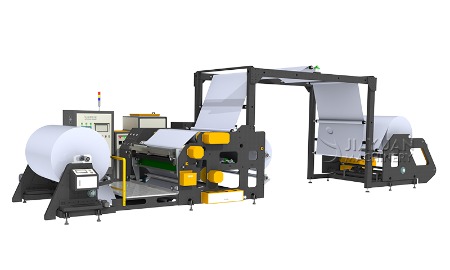
Adhesive coating machine
Quality control for release liner coating is focused on release force and its consistency. The release force is tested periodically using a standard PSA tape; the values must be within the specification. The coating weight is monitored online; the variation should be less than ±5%. The cure degree is verified by a rub test or by solvent extraction; the extractable silicone must be below a threshold. The liner's appearance is inspected for defects such as streaks, pinholes, or mottle. The adhesion of the silicone to the substrate is tested by an adhesion test; the silicone should not delaminate. The liner's release force is also tested after accelerated aging (heat, humidity) to ensure long-term stability. The quality data is recorded and analyzed using SPC. If the release force drifts, the cause may be a change in the silicone's viscosity, a variation in the coating weight, or a fluctuation in the oven temperature. The corrective action is taken: adjusting the pump speed, the gravure cylinder, or the oven's temperature profile. The process is validated for each release formulation; the validation includes the critical parameters and their acceptable ranges. In summary, rigorous quality control ensures that the release liner provides a consistent release force, which is essential for the proper function of PSA tapes and labels.