Release Liner Coating: Troubleshooting Defects, Process Optimization, and Sustainability Trends
Defects in release liner coating can cause significant problems in the downstream coating and converting of tapes and labels. Release variation (inconsistent release force) is the most critical defect. It is caused by non-uniform coating weight, uneven curing, or substrate surface variations. The solution is to check the coating head (gravure cylinder wear, slot-die gap), the oven's temperature uniformity, and the substrate's smoothness. Silicone transfer is the migration of silicone to the adhesive; it is caused by under-curing or excessive silicone coat weight. Increasing the curing temperature/time or reducing the coat weight solves it. Streaks are longitudinal defects from a damaged gravure cylinder or a dirty slot-die; cleaning or replacing the cylinder/die is corrective. Pinholes are caused by bubbles in the silicone; degassing the silicone and using a smoother substrate prevent them. Edge bead is managed by edge masking or by using a slot-die with tapered shims. Wrinkling of the liner is due to uneven tension; proper tension control and spreader rolls eliminate it. A systematic troubleshooting approach: define the defect, inspect the coating head and the liner, check the process parameters, test the silicone's viscosity and cure, and verify the oven's temperature profile. The corrective action is documented. Preventive maintenance includes regular cleaning of the coating head, replacing the gravure cylinder (when worn), calibrating the oven's thermocouples, and testing the silicone's reactivity. Operators should be trained to recognize and correct defects early, minimizing waste.
Process optimization for
release liner coating aims at reducing waste and increasing speed. The coat weight is the primary control; it must be just sufficient to provide the required release force. Using a solventless silicone eliminates the need for solvent recovery and reduces VOC emissions. The curing oven's energy consumption can be reduced by using UV curing (which requires less energy than thermal) or by improving the oven's insulation. The line speed is limited by the curing rate; using a faster-curing silicone (e.g., UV) can increase speed. The waste (startup, trim, and off-spec) is minimized by using a diverting valve and by optimizing the edge trim width. The machine's changeover time is reduced by using quick-change coating heads and pre-cleaned components. The optimization is an ongoing process; the data from the quality control system is used to fine-tune the parameters. In summary, process optimization improves the efficiency and profitability of release liner coating, reducing waste and energy consumption while maintaining consistent release properties.
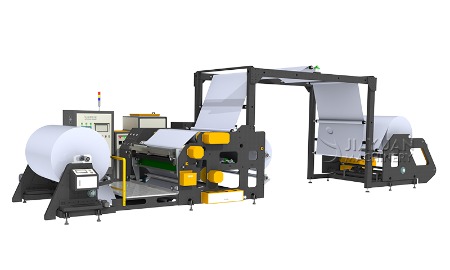
Adhesive coating machine
Sustainability is a significant trend in release liner coating. Solventless silicones (100% solids) are replacing solvent-based systems to eliminate VOC emissions and reduce energy use. They also simplify the coating process. The development of UV-curable silicones allows curing at lower temperatures, saving energy and enabling the use of heat-sensitive substrates. Bio-based release agents, derived from plant oils, are being researched as alternatives to petroleum-based silicones; they have the potential to be biodegradable and renewable. The recyclability of release liners is also important; silicone-coated paper can be repulped if the silicone is removable, and PET liners can be recycled if the silicone is compatible with the PET recycling stream. The coating machine must be adaptable to these new materials; for example, bio-based release agents may have different viscosity and curing behavior, requiring adjustments to the coating head and oven. The use of thinner liners (to save material) requires more precise coating and handling. In conclusion, release liner coating is evolving towards more sustainable practices, with new materials and processes that reduce environmental impact while maintaining the high performance required for PSA products. The coating industry must continue to innovate to meet these challenges and support the circular economy.