Reverse Roll Coater: Principles, Speed Ratio Control, and Coating Weight Prediction
Reverse roll coating is a variant of roll coating where the applicator roll rotates in the opposite direction to the substrate's travel. This counter-rotation creates a high shear rate in the fluid film, which breaks down agglomerates and produces a very smooth, uniform coating. The machine typically consists of a metering roll, a transfer roll (also called applicator roll), and a backing roll. The fluid is picked up by the metering roll from a pan, then doctored to a precise thickness by a gap between the metering and transfer rolls. The fluid film on the transfer roll is then applied to the substrate as it passes between the transfer roll and the backing roll. Because the transfer roll moves opposite to the web, the fluid is "wiped" onto the substrate rather than being dragged, which minimizes pinholes and air entrapment. Reverse roll coaters can achieve coat weights from 2 to 50 gsm with uniformity better than ±2%, making them suitable for high-quality photographic films, magnetic media, and optical coatings. The line speed can reach 300 m/min, and the coating width up to 3 meters.
The coating weight in reverse roll coating is determined by the metering gap (between metering and transfer rolls) and the speed ratio between the rolls. The metering gap sets the fluid layer thickness on the transfer roll. The transfer roll then carries this fluid to the nip. The speed ratio (transfer roll speed divided by web speed) is typically between 0.5 and 2.0. A ratio less than 1 means the transfer roll is slower than the web, which tends to produce a thinner coating because the fluid is stretched. A ratio greater than 1 gives a thicker coating because more fluid is delivered than the web can take away, resulting in pooling and backflow. The optimum ratio depends on the fluid viscosity and the desired coat weight. For low-viscosity fluids, a ratio near 0.8-1.0 is common; for high-viscosity, a ratio of 1.2-1.5 may be used. The relationship between coat weight and speed ratio is not linear; it can be modeled using a "pick-up ratio" that accounts for the fluid's rheology. Many modern reverse roll coaters have a control system that adjusts the speed ratio continuously based on feedback from online thickness gauges, maintaining the target coat weight despite variations in fluid properties or speed.
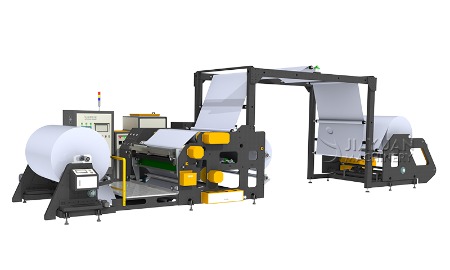
Adhesive coating machine
The gap setting is another critical parameter. The metering gap is set using a feeler gauge or laser sensor, typically ranging from 0.05 to 0.5 mm. This gap must be uniform across the width; any variation causes transverse thickness non-uniformity. The gap is set with the rolls stationary, but during operation, thermal expansion and hydrodynamic forces change the effective gap. Therefore, some coaters have a closed-loop gap control that uses load cells to measure the force between the rolls and adjusts the gap to maintain a constant force, which effectively compensates for thermal effects. The transfer roll and metering roll surfaces are usually chrome-plated and highly polished. The backing roll is often rubber-covered to provide a conformable nip that ensures uniform contact with the substrate. The nip pressure between the transfer roll and backing roll is controlled separately; it affects the transfer efficiency. Too high pressure can squeeze the fluid out, causing thin spots; too low pressure leads to incomplete transfer.
Predictive modeling of coat weight in reverse roll coating is an active area of research. The simplest model is: coat weight = (gap * fluid density * solids fraction) / (speed ratio + constant). More complex models incorporate the fluid's viscosity, surface tension, and the rolls' roughness. For practical purposes, operators often use a calibration curve generated by trial runs. However, with shear-thinning fluids, the effective viscosity changes with the speed ratio, making the curve non-linear. Process engineers use viscometry data to input into the control algorithm, which then calculates the required gap and speed ratio for a target thickness. Some advanced systems use a "model predictive control" that simulates the flow in the gap in real-time using a reduced-order model, adjusting parameters proactively before the thickness gauge detects a deviation. This allows the machine to run at higher speeds and with tighter tolerances.
Defects in reverse roll coating include "craters" (from surface tension imbalances), "orange peel" (from poor flow), and "ribbing" (from mechanical vibration). Craters are mitigated by adjusting the speed ratio to reduce shear thinning or by adding surfactants. Orange peel is reduced by increasing the temperature to lower viscosity or by increasing the speed ratio to enhance leveling. Ribbing is often due to roll eccentricity; ensuring rolls are balanced and bearings are in good condition is key. Also, "backflow" can occur at the nip when the transfer roll is much faster than the web, causing fluid to pool and drip; this is avoided by keeping the speed ratio within the recommended range. The fluid feed system must be free of pulsation; a gear pump with a pulse dampener is recommended. Regular maintenance includes cleaning the rolls, checking the gap calibration, and lubricating bearings.
reverse roll coaters are among the most precise roll coaters available, and with proper optimization, they can produce coatings of exceptional quality for demanding applications. Their ability to handle a wide viscosity range and their excellent uniformity make them a staple in the high-value coating industry.