Reverse Roll Coater: Roll Alignment, Nip Dynamics, and Transfer Efficiency
Roll alignment is the foundation of reverse roll coating quality. The applicator (transfer) roll, metering roll, and backing roll must be precisely parallel to each other within 0.01 mm/m. Misalignment causes a cross-web coating thickness gradient that cannot be corrected by speed ratio adjustments alone. Alignment is checked using a laser alignment tool or a dial indicator with a precision bar. The process involves measuring the gap at multiple points across the width and adjusting the roll bearings accordingly. Thermal expansion during operation can shift alignment; therefore, some machines are equipped with active alignment systems that use heaters or shims to compensate. The rolls must also be dynamically balanced to minimize vibration at high speeds. Unbalanced rolls cause periodic thickness variations (barring). Balancing is performed by adding or removing weight from the roll ends. Regular alignment checks—at least monthly—are recommended, especially after roll changes or maintenance.
Nip dynamics involve the interaction between the transfer roll and the backing roll. The nip pressure determines the contact width and the force that presses the substrate against the transfer roll. The pressure is typically applied by pneumatic cylinders or hydraulic actuators on the backing roll. The nip force is distributed along the roll length; any non-uniformity leads to uneven coating transfer. To ensure uniform pressure, the backing roll is often crowned (larger diameter at the center) to compensate for deflection under load. The crown profile is calculated based on the roll diameter, length, and expected load. Some coaters use a "Z" roller or a series of support rollers to distribute the load more evenly. The nip pressure should be set to the minimum necessary for complete transfer; excessive pressure can deform the substrate or squeeze out fluid, reducing coat weight. The pressure is monitored by load cells and adjusted via a PID controller. The nip opening time (dwell time) is also important; for high speeds, a smaller nip width is needed to keep the fluid from being squeezed sideways, which can cause edge bead.
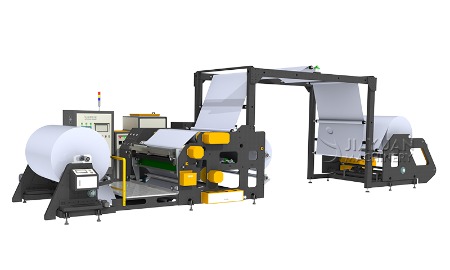
Adhesive coating machine
Transfer efficiency is the fraction of fluid on the transfer roll that is actually deposited onto the substrate. It is influenced by the relative speeds, nip pressure, and fluid properties. For reverse roll, the transfer efficiency is typically 60-90%. If the efficiency drops, the coating weight will decrease even if the metering gap is unchanged. Causes of low transfer efficiency include: nip pressure too low (incomplete contact), substrate surface energy too low (poor wetting), or fluid viscosity too high (insufficient flow). To improve efficiency, increase nip pressure, treat the substrate with corona, or warm the fluid to reduce viscosity. Some coaters have a "pre-wet" roll that applies a thin layer of solvent to the substrate to improve wetting. The transfer efficiency can be measured by weighing the fluid on the transfer roll before and after the nip, or by comparing the calculated coat weight from the metering gap to the actual measured coat weight. Regular monitoring helps detect changes in roll condition or fluid quality.
Roll wear is inevitable and affects both gap and surface finish. The metering roll and transfer roll surfaces are subject to abrasion from fillers and to chemical attack from solvents. The wear pattern is usually non-uniform, often worse at the edges due to higher shear. To track wear, operators measure the roll diameter at several points along the length at defined intervals. When the diameter drops by more than 0.05 mm, the roll should be re-ground. The grinding process restores the profile and surface roughness. The frequency of regrinding depends on the coating's abrasiveness; for electrode slurries with carbon, regrinding may be needed every 200 hours; for soft adhesives, every 1000 hours. Re-chroming is done after several regrinds to restore hardness. The backup roll's rubber cover also wears and can develop flat spots; it should be re-covered or ground as needed. All maintenance actions should be documented in a roll history file to predict when the next service is due.
Process stability in reverse roll coating requires consistent fluid properties. The coating supply system must include a tank with temperature control and agitation to prevent settling. The fluid should be filtered to remove agglomerates that could scratch the rolls. The pump flow rate must be matched to the coating consumption; a return line to the tank allows recirculation to maintain a constant head. The fluid level in the pan must be controlled to prevent starvation or flooding. Additionally, the web tension must be stable; tension fluctuations cause speed changes at the nip, affecting coat weight. Dancer rolls and load cells provide active tension control. The drying or curing section after the coater must be synchronized; any changes in web speed will affect drying time and may cause defects. Modern
reverse roll coaters are integrated with a central control system that monitors all key parameters—speeds, gaps, pressures, temperatures, and coat weight—and provides alerts when any parameter drifts. With diligent mechanical maintenance, nip optimization, and fluid management, reverse roll coaters deliver high precision and reliability, making them indispensable for premium coating applications.