Rewind Tension Control: Principles of Winding, Torque Control, and Roll Quality
The rewinder is the final module of the coating line, where the coated web is wound into a roll. The winding tension must be carefully controlled to produce a roll that has the correct density (hardness) and is free of defects. The tension is applied by the rewinder's driven shaft, which imparts torque to the core. The torque required is tension multiplied by the roll radius. As the roll diameter increases, the torque must increase linearly to maintain constant tension. However, in practice, a constant tension throughout the winding process can cause problems: at the start, the small core requires low torque, but at the end, the large roll requires high torque, which can compress the inner layers and cause blocking (sticking) or bursting (crushing). Therefore, a "taper tension" profile is used: the tension is gradually reduced as the roll diameter grows, to maintain a uniform internal pressure. The taper factor is typically 10-30%. The control system calculates the torque based on the tension setpoint, the taper factor, and the measured roll diameter. The diameter is measured by a sensor (e.g., ultrasonic or laser) or calculated from the line speed and the roll's rotational speed. The drive motor is typically an AC servo or a vector-controlled motor with a VFD, providing precise torque control. The tension feedback is from a load cell on a dancer roll or a nip roll. The control loop adjusts the motor torque to maintain the setpoint. The rewinder also has a "lay-on" roll that presses the web onto the winding roll to remove air and ensure a tight wind. The lay-on pressure must be controlled; too high can crush the roll, too low can trap air, causing telescoping.
The quality of the wound roll is critical for customer satisfaction and downstream processing. A good roll has a smooth, straight face, uniform hardness across the width, and no telescoping (lateral shifting of layers). Telescoping occurs when the tension is too low or when the web guide is not centered; it causes the layers to slide sideways, making the roll unusable. To prevent telescoping, the rewinder must have a precise edge guide that keeps the web centered. The winding tension must be sufficient to hold the layers together but not so high that it causes blocking. The lay-on pressure should be applied at the center of the roll to avoid edge pressure marks. The roll's hardness is measured by a durometer or by a "roll density" gauge. The optimum hardness depends on the substrate and the coating; for adhesive tapes, a softer roll is often preferred to prevent adhesive squeeze-out. The taper tension setting is the primary adjustment for hardness; increasing the taper (more reduction) produces a softer roll. The taper is set in the recipe and can be adjusted based on the roll's appearance. The rewinder also has a "slow-down" feature: near the end of the roll, the speed is reduced to allow the web to be cut and the roll removed. The tension during this slow-down must be maintained to avoid a loose tail.
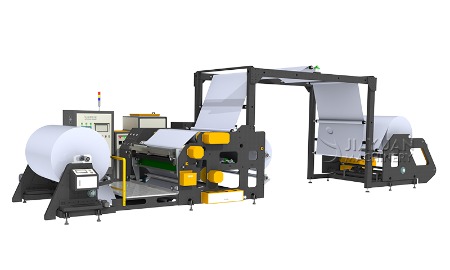
Adhesive coating machine
Winding defects are common and can be costly. "Blocking" occurs when the adhesive (or coating) sticks to the backside of the web, making it impossible to unwind. This is caused by excessive winding tension, high temperature, or insufficient drying. The remedy is to reduce tension, lower the roll's temperature, or improve drying. "Telescoping" is due to low tension or poor alignment; increase tension and check the edge guide. "Bursting" or "crushing" happens when the roll's internal pressure exceeds the web's strength, causing a star-shaped pattern on the roll face; reduce taper or use a larger core. "Wrinkling" occurs when the web is wound with transverse folds; increase tension or use a spreader roll. "Air entrapment" causes soft spots and can lead to slippage; increase lay-on pressure or use a grooved lay-on roll to allow air to escape. "Edge damage" is caused by misalignment; check the edge guide and the core's positioning. The operator should visually inspect each roll and use a hardness tester to ensure consistency. All defects should be logged and correlated with the winding parameters to enable corrective action.
Advanced rewinders include automatic roll change systems (turret rewinders) that allow the line to continue during roll changeovers. The turret rotates a new core into position, and the web is cut and transferred automatically. The tension during the transfer must be maintained; a festoon accumulator stores enough web to allow the changeover without stopping the line. The control system executes a sequence: slow down, accelerate the new core to match speed, apply adhesive, cut, and transfer. The tension is controlled throughout. The turret rewinders are common in high-speed lines. The maintenance of the rewinder includes checking the bearings, the lay-on roll, the cut-off knives, and the core chuck. The chuck must grip the core firmly to prevent slippage; worn chucks cause tension loss. The lay-on roll's surface must be clean and smooth; any deposit can mark the roll. In summary,
rewind tension control is a delicate balance between achieving a tight roll and avoiding damage. By using taper tension, precise torque control, and careful monitoring, operators can produce high-quality rolls that meet customer expectations and are ready for shipment or further conversion. The rewinder is often the last chance to correct defects, so it deserves careful attention.