Rewind Tension: Impact on Roll Hardness, Storage Stability, and Slitting Performance
The hardness of a wound roll is a key quality attribute. A roll that is too hard may be difficult to slit because the blades experience high friction; it may also cause the core to collapse. A roll that is too soft may telescope during storage or transportation, and may unwind with poor tension control. The hardness is determined by the winding tension profile, the substrate's compressibility, and the lay-on pressure. For a given substrate, increasing the tension or reducing the taper produces a harder roll. The optimal hardness is often specified by the customer or by the slitting department. To achieve a target hardness, the operator can adjust the taper factor and the base tension. A common method is to use a "hardness test" with a durometer on several sample rolls; the correlation between tension settings and hardness is used to set the recipe. The tension should also be adjusted for the roll's width; wider rolls require higher tension to maintain the same hardness due to the increased inertia. The roll's diameter also affects the hardness; larger rolls need more taper to prevent excessive pressure on the inner layers. Therefore, the tension profile is typically a function of both the diameter and the width. Many rewinders have a "hardness control" mode where the operator inputs the target hardness, and the system calculates the required taper.
Storage stability is another concern. Rolls may be stored for days or weeks before being converted. If the winding tension is too high, the adhesive may slowly flow out, causing blocking or oozing. If the tension is too low, the roll may telescope due to the release of residual stresses. The ambient temperature and humidity also affect the roll; high temperature can soften the adhesive, causing the roll to deform. Therefore, the rolls should be stored in a temperature-controlled environment. The tension should be set so that the roll's internal pressure is below the threshold that causes creep. This is especially important for hot-melt adhesives, which are more sensitive to temperature. The roll should be wound on a core that is strong enough to support the weight; if the core collapses, the roll will be unusable. The core's crush strength must be known; the winding tension should not cause the core to deform. The roll's weight is also a factor; heavier rolls require a more robust core. In summary, the
rewind tension must consider the entire lifecycle of the roll, from winding to storage to slitting.
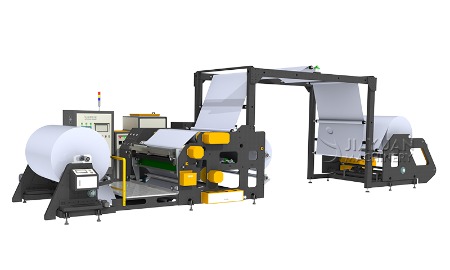
Adhesive coating machine
Slitting performance is directly affected by roll hardness. Slitting machines cut the master roll into narrower rolls. If the roll is too hard, the blades wear quickly and may produce ragged edges. If the roll is too soft, the blades may push the layers apart, causing "fuzz" or poor edge quality. The optimal hardness for slitting is usually a medium level, where the blades can cut cleanly without excessive friction. The slitting department often provides feedback to the coating line; if the slitter reports poor edge quality, the rewinder tension may need adjustment. The roll's hardness profile across the width is also important; if the roll is harder at the edges, the slitter may have difficulty. This can happen if the lay-on pressure is uneven; checking the lay-on roll's parallelism is necessary. The slitting speed also affects the required hardness; high-speed slitting favors a harder roll to prevent vibration. Therefore, the tension setpoint should be coordinated with the slitting process. Many plants have a "rewind tension" recommendation for each product, based on historical slitting performance.
Practical guidelines for rewind tension: (1) Determine the base tension from the substrate's tensile strength (typically 10-20% of yield); (2) Set the taper factor based on the roll diameter (e.g., 10% for small rolls, 20% for large rolls); (3) Adjust the lay-on pressure to remove air without crushing; (4) Monitor the roll's surface temperature; if it is warm, reduce tension to avoid adhesive softening; (5) Use a hardness tester to verify the roll's quality; (6) Adjust the tension if the slitter reports issues; (7) Document the tension settings and hardness readings for each product; (8) Train operators on the visual signs of good and bad rolls. By following these practices, the coating line can produce rolls that are stable, easy to handle, and ready for high-quality slitting. The rewind tension is a critical link between coating and converting, and its proper management ensures the final product meets all expectations.