Roll Coating Machine: Maintenance, Roll Coverings, and Troubleshooting Guide
Roll coating machines are mechanical workhorses, and their reliability depends on regular maintenance of rolls, bearings, seals, and drive systems. The rolls are the most critical components; they must maintain precise geometry, surface finish, and hardness. Over time, rolls wear, develop flat spots, or get scratched by abrasive fillers in the coating. For rubber-covered rolls, the surface can harden, crack, or swell due to solvent attack. Therefore, a scheduled inspection program is essential. Daily checks include visual inspection for surface damage, cleaning with a soft cloth and mild solvent, and verifying nip pressure indicators. Weekly checks involve measuring roll parallelism with a feeler gauge or laser alignment tool, and lubricating bearings according to the manufacturer's schedule. Monthly, the roll surface should be profiled for roundness and taper; any deviation beyond 0.05 mm requires grinding. The backup roll's rubber cover should be tested for hardness using a durometer; if hardness changes by more than 5 Shore points, the roll should be replaced or re-covered.
Roll coverings come in various materials, each with specific advantages. Natural rubber is economical and has good tear resistance but poor solvent resistance. Nitrile rubber (NBR) offers excellent oil and solvent resistance, making it ideal for solvent-based coatings. Ethylene-propylene (EPDM) rubber resists water and heat, suitable for water-based and hot-melt systems. Polyurethane (PU) covers provide high abrasion resistance and load-bearing capacity, used for high-pressure nips. For metering rolls, chrome-plated steel is common because it is hard, corrosion-resistant, and easy to clean. Ceramic-coated rolls are used for highly abrasive coatings. The choice of covering affects the coating quality: softer rolls conform better to uneven substrates but wear faster. The durometer hardness typically ranges from 60 Shore A (soft) to 95 Shore A (hard). When re-covering, the roll must be re-ground to its original diameter and profile. It is also important to match the surface roughness (Ra) to the coating fluid; for low-viscosity fluids, a smoother roll (Ra < 0.5 µm) is needed to prevent dripping.
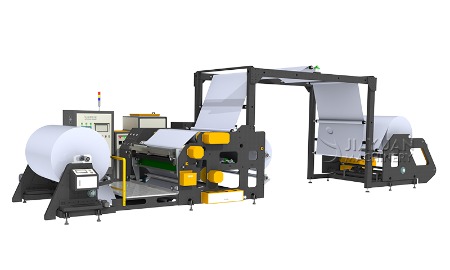
Adhesive coating machine
Cleaning is a daily necessity to remove dried coating residues that cause streaks and scratches. For solvent-based coatings, use the same solvent as the carrier, applied with a lint-free cloth; never use metal scrapers that can damage the roll. For water-based coatings, warm water with mild detergent is effective, followed by thorough drying. For hot-melt adhesives, a hot oil or specialized flushing compound is used. Some roll coaters have automatic cleaning systems with oscillating brushes and solvent spray bars that reduce manual labor. However, manual inspection is still needed to ensure all residue is removed. After cleaning, the rolls should be dried and lightly oiled (for steel rolls) to prevent rust. The coating pan also needs regular draining and cleaning to prevent sedimentation and bacterial growth. All cleaning records should be logged to track solvent usage and detect any changes in cleaning frequency, which may indicate a problem with the coating formulation.
Bearings and seals are frequent failure points. Roll bearings must withstand high loads and speeds; they should be greased or oil-bathed per the manufacturer's interval. Over-greasing can cause overheating; under-greasing leads to wear and vibration. Seals prevent fluid from entering bearings; they should be inspected for leakage and replaced if swollen or cracked. Drive systems—gearboxes, belts, chains, and motors—need periodic tension and alignment checks. A common symptom of drive issues is speed fluctuation, which causes coat weight variation. Encoder feedback should be verified against a tachometer. Electrical motors should have their current draw monitored; an increase may indicate binding or overload. Maintenance logs that track bearing temperatures and vibration levels help predict failures before they occur, enabling planned downtime rather than sudden breakdowns.
Troubleshooting roll coaters involves a systematic approach. If the coating is streaky, first check the roll surface for scratches or dried residue; clean or polish the roll. If the streak persists, inspect the doctor blade or metering gap for foreign particles. If coating weight is uneven across the width, check roll parallelism and nip pressure profile; adjust the nip actuators. If the coating has orange peel, increase the fluid temperature or add a leveling agent. If there is excessive edge bead, adjust the edge masking or reduce the nip pressure at the edges. If the coating is skipping—intermittent gaps—the web tension may be too low or the roll speed ratio incorrect; increase tension or adjust the ratio. A troubleshooting flow chart posted near the machine helps operators quickly identify likely causes. Always involve the coating supplier when the fluid itself is suspected. Regular training of operators on maintenance and troubleshooting reduces dependency on engineers and minimizes downtime. By investing in a robust maintenance program and understanding the root causes of defects,
roll coating machine owners can achieve long service life, consistent product quality, and lower overall operating costs.