Roll Coating Machine: Principles, Roll Configurations, and Process Variables
Roll coating is one of the oldest and most versatile coating methods, relying on the mechanical transfer of fluid from a rotating roll to a moving web. The basic principle involves a metering roll and an applicator roll. The metering roll picks up coating from a pan or reservoir, and a doctor blade or a second roll controls the amount of liquid carried. The applicator roll then deposits the liquid onto the substrate as it passes through the nip—the contact point between the applicator roll and a backup roll. The coating thickness is determined by the gap between the metering and applicator rolls, the roll speeds, and the fluid's rheology. Roll coaters can handle a wide range of viscosities, from thin varnishes (50 cP) to heavy pastes (50,000 cP), making them ideal for paper, film, foil, and textile coating. They are also economical, with lower capital costs compared to slot dies or gravure systems, and they permit rapid product changeovers.
There are several roll configurations, each suited to different coat weight ranges and accuracy levels. The simplest is the two-roll coater, where one roll picks up fluid and transfers it directly to the substrate backed by a second roll. This is used for heavy coatings (50-200 gsm) with moderate uniformity. The three-roll coater adds a doctor roll to scrape excess fluid from the applicator roll, improving control. The four-roll coater, or "reverse roll" coater, uses a metering roll rotating opposite to the applicator roll, which shears the fluid and provides excellent thickness control down to 5-10 gsm with ±2% uniformity. Another variant is the "nip feed" coater, where the coating is fed into the nip between two rolls, eliminating the need for a pan. Each configuration affects the coating's surface finish and edge bead characteristics. The choice depends on the desired coat weight, line speed, and fluid properties.
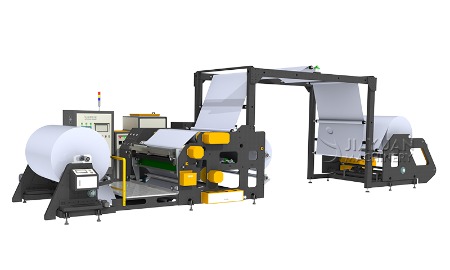
Adhesive coating machine
Key process variables in roll coating include nip pressure, roll speed ratio, roll surface hardness, and fluid temperature. Nip pressure determines the contact width and the force applied to the substrate; excessive pressure can deform the web or cause oozing, while insufficient pressure leads to poor transfer and skipping. Typically, nip pressures range from 10 to 100 N/mm, adjusted by pneumatic or hydraulic cylinders. The speed ratio between the metering roll and the applicator roll controls the shear rate and, hence, the fluid film thickness. A higher speed difference reduces the coating weight. The surface hardness of the rolls—measured in Shore A or Shore D—affects the nip deformation and the fluid distribution; soft rubber rolls (Shore A 60-80) are used for conformal coating on uneven substrates, while chrome-plated steel rolls are for precise metering. Fluid temperature must be maintained to ensure constant viscosity; many roll coaters include heated pans and rolls for hot-melt or high-viscosity materials.
The coating weight in roll coating is also influenced by the fluid's surface tension and the substrate's absorbency. For porous substrates like paper, capillary action pulls fluid into the pores, reducing the surface coating thickness. This requires adjusting the pickup roll gap to compensate. For non-porous films, the coating weight is purely a function of the fluid layer thickness on the applicator roll. The transfer ratio—the fraction of fluid transferred from the applicator roll to the web—is typically 30-70%, depending on the nip conditions and web speed. To achieve uniform coat weight across the width, the rolls must be perfectly parallel; misalignment causes thicker coating on one side. Regular alignment checks using dial gauges or laser systems are necessary. Additionally, roll surface roughness must be controlled; a smoother roll gives a thinner, glossier coating, while a rougher roll yields a thicker, matte finish. Periodic grinding and re-chroming of rolls are required to maintain surface quality.
Defects in roll coating include orange peel, ribbing, chatter marks, and edge bead. Orange peel results from poor flow and leveling, often due to high viscosity or low temperature; reducing viscosity with solvent or heat helps. Ribbing—periodic transverse lines—is caused by mechanical vibration or unstable fluid flow; it can be minimized by damping the roll drive or adjusting the speed ratio. Chatter marks are high-frequency ripples from roll eccentricity or bearing wear; replacing worn bearings and balancing rolls solves this. Edge bead is the thickening at the web edges due to surface tension; edge masking or using a wider web with trimming is common. Operators should monitor the coating visually and with online thickness gauges, adjusting parameters in real-time. Regular cleaning of rolls with appropriate solvents prevents dried buildup that causes streaks. In summary,
roll coating machines offer a robust, cost-effective solution for many industrial coatings. Their success hinges on understanding the interplay between roll geometry, operating conditions, and fluid properties. With proper setup and maintenance, they deliver consistent quality at high speeds, making them a staple in converting, packaging, and building material industries.