Roll-to-Roll Coating: Advanced Tension Control, Splice Management, and Defect Prevention
Advanced tension control in R2R coating goes beyond basic PID. For high-speed lines (e.g., >400 m/min), the tension control system must have a high bandwidth (10-20 Hz) to reject disturbances from roll eccentricity, motor ripple, and splice transients. A common approach is to use a cascade control: an inner torque loop with a fast current controller, and an outer tension loop with a slower PID. The torque loop compensates for motor and drive dynamics, while the tension loop sets the torque setpoint. Feedforward control is used to anticipate tension changes due to acceleration or deceleration: the torque required to accelerate the roll inertia is calculated and added to the tension torque. This reduces the tension error during speed ramps. Dancer rolls provide a mechanical buffer: they absorb tension variations by moving up or down, and their position is used as a feedback signal. Some advanced systems use a "virtual dancer" algorithm that simulates the dancer's behavior using the load cell signal, eliminating the mechanical dancer. In summary, advanced tension control ensures stable operation at high speeds and during transients.
Splice management is critical in R2R coating because splices—the joints between rolls—are a source of tension transients and coating defects. The line must handle a splice without stopping; a festoon accumulator stores enough web to allow the line to continue at full speed while the new roll is spliced. The splice itself is a reinforced tape joint; it has a different thickness and stiffness than the substrate, causing a tension spike and a potential coating defect. To manage this, the control system has a "splice detection" sensor (e.g., a photoelectric or ultrasonic sensor) that signals the control system to: (1) Reduce the tension setpoint temporarily by 10-20% to reduce the stress on the splice; (2) Adjust the coating head's gap slightly to compensate for the thickness change; (3) Mark the coated web at the splice location so that the defective section can be removed later. The splice transient is often the most challenging disturbance; the control system's response must be fast and smooth. The operator can also manually adjust the tension reduction percentage based on the splice quality. In summary, effective splice management minimizes waste and prevents web breaks.
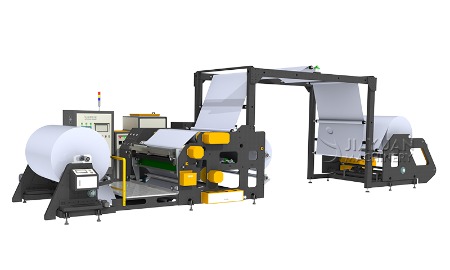
Adhesive coating machine
Defect prevention in R2R coating involves a multi-pronged approach. Wrinkles are a common defect caused by uneven tension or misaligned rolls. To prevent wrinkles, the tension profile across the width must be uniform; using a spreader roll (a curved roll that stretches the web outward) can eliminate wrinkles. Web breaks are caused by excessive tension, nicks in the web, or weak splices; the tension limit should be set below the web's tensile strength. Coating non-uniformity (thick or thin areas) can be due to variations in the coating head's gap, pump pulsation, or oven temperature; regular calibration and maintenance are essential. Edge bead is caused by surface tension; using edge masking or a tapered shim can reduce it. Pinholes are caused by bubbles or dust; degassing the fluid and filtering are required. The operator should follow a checklist for defect prevention: check the roll surfaces, clean the dies, calibrate the gauges, and monitor the tensions. In summary, proactive defect prevention is more effective than reactive troubleshooting.
Maintenance of an R2R line is essential for long-term reliability. The rolls must be cleaned and inspected regularly; bearings must be lubricated; the coating head must be disassembled and cleaned; the oven's filters and heaters must be checked; the drives must be calibrated. A predictive maintenance program using vibration analysis, thermography, and oil analysis can detect incipient failures before they cause downtime. The spare parts inventory should include critical components: belts, bearings, sensors, shims, and filters. The maintenance schedule should be based on the machine's operating hours and the manufacturer's recommendations. A well-maintained R2R line can achieve an uptime of 95% or higher. In conclusion, advanced tension control, splice management, and defect prevention are the keys to achieving high-quality, high-speed R2R coating with minimal waste. By investing in these areas, the coating line can operate at its full potential, delivering consistent products to the market.