Roll-to-Roll Coating: Principles, Web Handling, and Process Control for High-Volume Flexible Substrates
Roll-to-roll (R2R) coating is a continuous manufacturing process where a flexible substrate is unwound from a roll, passed through a series of processing stations, and rewound onto another roll. The substrate can be plastic films (PET, PP, PI), metallic foils (aluminum, copper), paper, nonwovens, or textiles. The coating station applies a liquid layer, which is then dried or cured, and the final product is wound. R2R coating enables high-volume production at low cost, making it the standard for products like adhesive tapes, labels, packaging films, battery electrodes, and flexible electronics. The key advantage is the continuous nature: once the line is running, it can produce thousands of meters of coated substrate with minimal operator intervention. The line speed typically ranges from 50 to 600 m/min, depending on the substrate and the coating thickness. The width can be from 0.5 to 5 meters. The R2R line consists of several modules: (1) Unwinder: a turret or shaft unwinder with a brake to provide back tension. (2) Surface treatment: corona, flame, or plasma treater to increase surface energy. (3) Coating head: slot-die, gravure, roll, or comma. (4) Drying/curing: oven, IR, or UV. (5) Laminating station (optional). (6) Inspection system: camera and thickness gauge. (7) Rewinder: a turret winder with taper tension control. The entire line is controlled by a central PLC that synchronizes the drives and maintains the tension. In summary, R2R coating is a complex system that integrates multiple processes into a continuous, high-speed operation.
Web handling is the backbone of R2R coating. The substrate must be transported through the line without wrinkles, stretching, or tearing. Tension control is the most critical aspect: the tension must be high enough to keep the web taut but low enough to avoid deformation. The line is divided into tension zones: the unwinding zone, the coating zone, the oven zone, and the rewinding zone. Each zone has a separate tension setpoint. The tension is measured by load cells on idler rolls or by dancer rolls. The tension is controlled by adjusting the torque of driven rolls (pull rolls) or the braking torque of the unwinder/rewinder. The control system uses a cascade of PID loops: a master speed loop for the main pull roll, and individual tension loops for each zone. For high-speed lines (>300 m/min), feedforward control is used to compensate for the roll inertia during speed changes. The edge guide maintains the web's lateral position, using photoelectric or ultrasonic sensors and a steering roll. The web tracking—the path of the web through the rolls—must be straight; any misalignment causes wrinkles. Regular alignment checks using laser tools are essential. In summary, robust web handling ensures that the substrate is transported smoothly and consistently, which is the foundation of uniform coating.
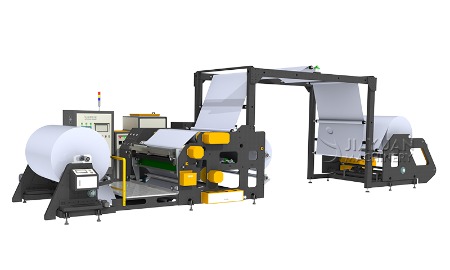
Adhesive coating machine
The coating head in an R2R line must be designed for high-speed operation and easy cleaning. Slot-die coating is the most precise and versatile, handling a wide viscosity range and providing excellent uniformity. Gravure is used for thin, high-speed coatings. Roll coating is economical for less demanding applications. The coating head is mounted on a precision carriage that allows adjustment of the die-to-web gap (for slot-die) or the nip pressure (for roll coating). The coating head must be synchronized with the line speed; the pump flow rate is set as a ratio of the line speed. A feedback loop from the thickness gauge adjusts the pump speed to correct any errors. The coating head must be accessible for cleaning; many R2R lines have a "swing-out" or "slide-out" mechanism that moves the head out of the web path for maintenance. The coating head is often enclosed to contain solvent vapors and to protect the bead from dust. In summary, the coating head is the heart of the R2R line, and its design and maintenance are critical for quality and productivity.
The drying/curing section in an R2R line is often the longest part, as it must remove solvents or water and, in some cases, crosslink the coating. The oven is typically a convection type with multiple zones. The web is supported by rollers or by air flotation to prevent sagging. The oven's temperature and airflow are controlled to achieve the required drying rate. The residence time is determined by the line speed and the oven length; for high speeds, the oven must be long or use high-velocity impingement air. The oven's exhaust is connected to a solvent recovery system for solvent-based coatings. For UV curing, a UV lamp bank is installed after the coating head; the web is exposed to UV light for a short time. The curing section must be matched to the coating's chemistry and the line speed. In summary, the drying/curing section is a major factor in determining the line's maximum speed and product quality.
Rewinding is the final step; the coated web is wound into a finished roll. The rewinder must apply controlled tension to produce a roll with the correct hardness, without blocking or telescoping. Taper tension—reducing the tension as the roll diameter increases—is used to maintain a constant internal pressure. The rewinder may have a lay-on roll to remove air and ensure a tight wind. The rewind tension is controlled by a torque loop, with the roll diameter measured by a sensor. The finished roll is then sent to slitting and converting. Quality control in R2R coating involves inline inspection for defects (streaks, pinholes, edge bead) and coat weight measurement. The inspection data is used for process adjustment and for quality reporting. In conclusion, R2R coating is a highly automated, continuous production process that demands precision in web handling, coating, and drying. By mastering these aspects, manufacturers can achieve high output, consistent quality, and low unit cost, making R2R coating the backbone of the converting industry.