Slot Die Coating: Defect Diagnosis, Process Optimization, and Advanced Applications
Slot die coating, despite its precision, is prone to a set of characteristic defects that stem from the bead dynamics, the mechanical precision of the die, or the fluid's properties. One of the most common defects is "die lines"—permanent, fine longitudinal streaks. They are almost always caused by damage to the die lip (a nick or scratch) or by a foreign particle lodged in the slot. The solution is to inspect the lip under a microscope; if damaged, the lip is polished with a diamond-impregnated stone or re-machined. If a particle is trapped, the die must be disassembled, cleaned, and reassembled. In some cases, the shim may have a wrinkle or burr; replacing the shim solves it. Another frequent defect is "edge bead"—a thickening of the coating at both edges. Edge bead arises from surface tension pulling the fluid from the edge inward, and from the pressure gradient at the edge of the slot. To reduce edge bead, shims with tapered ends (chamfered) are used; this gradual reduction in slot gap lowers the local flow. Additionally, edge vacuum is applied to remove excess fluid, or an edge air knife blows it away. Active edge control using small actuators at the edges is also available. If edge bead is still too prominent, the common practice is to coat slightly wider than the substrate width and trim the edges after drying, though this adds waste.
"Barring" is a periodic thickness variation in the machine direction that appears as transverse bands. It is often due to a mechanical vibration of the die or the web. The vibration can originate from the pump's pulsation (if the pulse dampener is insufficient), from an eccentric roll in the tension system, or from a resonance in the machine frame. Barring is diagnosed by measuring the frequency of the thickness oscillation and comparing it to the rotational speed of potential components. Solutions include installing a better pulse dampener, balancing rolls, adding damping mounts, or changing the die's mounting stiffness. "Pinholes" are microscopic holes through the coating, caused by bubbles in the fluid or by air entrainment at the bead. Bubbles can be removed by degassing (vacuum or ultrasonic). Air entrainment occurs when the vacuum level is too low or the die gap is too large; increasing vacuum or reducing gap helps. Also, the fluid's surface tension should be lowered to improve wetting, which reduces the chance of air being trapped. "Mottle" or "orange peel" is a surface roughness defect due to poor leveling; this is corrected by increasing the fluid temperature (lower viscosity) or adding a leveling agent. For all defects, a systematic root-cause analysis using a fishbone diagram and process data is recommended. Maintaining a defect log that links each occurrence with the operating conditions (flow, speed, gap, vacuum, temperature) enables pattern recognition and faster corrective actions.
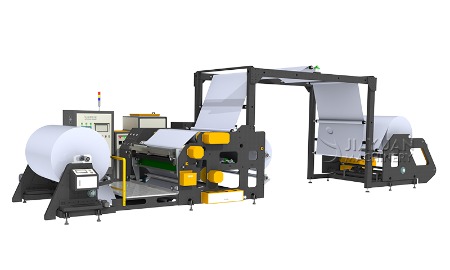
Adhesive coating machine
Process optimization in
slot die coating aims to maximize the coating window, reduce coat weight variation, and minimize defects. The optimization typically starts with the fluid characterization: measuring viscosity vs. shear rate, surface tension, and density. Then, using a pilot coater, a design of experiments is conducted varying the die gap, vacuum level, die angle, and web speed, while measuring the resulting coat weight and bead stability. The results are used to construct a coating window map. The optimal operating point is usually at the center of the window to allow some margin for disturbances. Additionally, the pump flow rate is adjusted to achieve the target wet thickness; the relation is: wet thickness = flow rate per unit width / web speed. For a given dry target, the wet thickness is the dry thickness divided by the solids fraction. The pump speed is then set accordingly, with a correction factor for the fluid's compressibility and any slip. Online thickness gauges (beta, X-ray, or optical) provide continuous feedback; the control system uses a PID loop to adjust pump speed to maintain target. For better transient response, a cascade loop with a pressure sensor at the die inlet can anticipate flow changes before the gauge detects them. Also, the die temperature can be adjusted to fine-tune viscosity; if the coat weight drifts due to temperature change, the controller can slightly heat or cool the die to correct it. Advanced optimization includes using model predictive control that uses a process model to forecast the effect of speed changes on coat weight and pre-adjusts the pump accordingly, minimizing overshoot during speed ramps.
Specialized applications present unique challenges. In lithium-ion battery electrode coating, the slurry is a high-solids, high-viscosity fluid containing active materials, carbon black, and binder. The slot die must handle abrasive particles that wear the lip; therefore, the die is often coated with tungsten carbide. The coating thickness must be extremely uniform (typically ±1.5%) to ensure consistent cell capacity. The process is run at relatively low speeds (20-80 m/min) due to the thick coating and long drying requirement. Edge bead is particularly problematic because the trimmed edges are waste; active profile control with thermal actuators is used to maintain edge thickness. The drying oven must be very long to avoid blistering, and the line often includes a calendering step after drying to densify the electrode. In optical film coating (e.g., polarizer films, anti-reflective layers), the fluid is low-viscosity and the required thickness is sub-micron to a few microns. The slot die must operate in a cleanroom (Class 100) to avoid particle contamination, and the die gap is extremely small (often < 0.1 mm). Vacuum level must be tightly controlled, and the die angle is critical. The coated film must have no optical defects; inline inspection uses laser scattering to detect micro-defects. The drying is done with floating air ovens to avoid contact. For adhesive tape coatings, the fluid is often highly viscoelastic; the coating window may be narrow, and careful rheological tuning is needed. In all advanced applications, close collaboration with the adhesive/fluid supplier, the die manufacturer, and the automation vendor is essential to achieve the rigorous specifications. The future of slot die coating lies in further integration of in-line rheometry, machine learning for defect classification, and self-optimizing systems that can adapt to batch-to-batch variations. These technologies will make slot die coating even more robust and efficient, expanding its use into new fields such as printed electronics, biosensor fabrication, and advanced composite materials.