Slot Die Coating: Fundamentals of Fluid Mechanics and Process Stability
Slot die coating is a pre-metered coating technique where a liquid is pumped through a narrow slot onto a moving web. The coat weight is determined solely by the pump flow rate and the web speed, making it inherently accurate and independent of fluid viscosity (within limits). The core fluid mechanics involve three distinct regions: the internal flow within the die manifold and slot, the external flow in the liquid bead between the die lip and the web, and the final film flow on the substrate. The internal flow must distribute the incoming fluid uniformly across the width; this requires a manifold designed to compensate for pressure losses. The pressure at any point in the slot depends on the fluid's viscosity, the slot gap, and the flow rate. The pressure drop through the slot is typically 10-50 bar for high-viscosity fluids. The downstream bead region is where the liquid bridge is formed; it is stabilized by the balance between viscous forces, surface tension, and the vacuum applied on the downstream side. The bead is a critical zone; any perturbation can cause defects. The film flow on the web after the bead undergoes leveling due to surface tension and then may be disturbed by any residual stresses. Understanding these three flow regions is essential for designing the slot die and setting process parameters.
The stability of the liquid bead is the central challenge in slot die coating. The bead is bounded upstream by the upstream meniscus and downstream by the downstream meniscus (near the vacuum box). The upstream meniscus is where the fluid meets the moving web; the downstream meniscus is where the fluid exits the die lip. For a stable bead, the pressure in the bead must be lower than the ambient pressure (hence the vacuum) to keep the menisci in place. The stability limits are often represented by the "coating window"—a plot of flow rate per unit width (or wet thickness) versus web speed. The window is bounded by several failure modes: at low flow rates, the bead breaks due to insufficient fluid (low-flow break); at high flow rates, the bead drips or overflows (high-flow drip); at low speeds, air entrainment occurs because the fluid cannot wet the web fast enough; at high speeds, the bead oscillates or becomes unstable due to inertia. The coating window is fluid-specific; for a given fluid, operators must find the operating point within the window that achieves the target coat weight at the desired speed. The window can be expanded by adjusting the die-to-web gap, the vacuum level, the die angle, and the fluid temperature (which changes viscosity and surface tension). Numerical simulations using the Navier-Stokes equations with a free surface model can predict the coating window and guide optimization. Many advanced slot-die lines use an automated "window-mapping" routine that systematically varies flow and speed while monitoring bead stability via a high-speed camera, generating a stability map for each fluid. This reduces trial-and-error and accelerates startup.
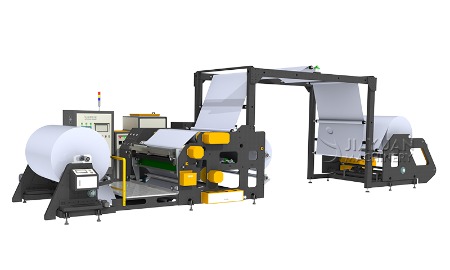
Adhesive coating machine
Viscoelastic effects are significant in many coating fluids, such as polymer solutions, adhesives, and battery slurries. These fluids exhibit both viscous and elastic behavior. During
slot die coating, the fluid experiences high shear rates in the slot and extensional flow in the bead. The elastic stresses can cause "die swell"—the fluid expands after exiting the slot—which changes the effective coating thickness. Also, elastic instabilities can lead to "melt fracture" or "sharkskin" defects, where the coated surface appears rough. To mitigate these, the die design should minimize extensional strain, and the operating conditions should keep the Deborah number (ratio of relaxation time to process time) below a critical value. The fluid's rheology should be characterized by oscillatory shear and extensional viscometry; the data can be used in constitutive models (e.g., Giesekus, Phan-Thien-Tanner) to simulate the coating flow. Some slot-dies include a "relaxation chamber" or a "pre-land" section to allow elastic stresses to decay before the fluid exits the slot. Alternatively, the die can be heated to reduce the relaxation time. The addition of small amounts of high-molecular-weight polymer can enhance bead stability by increasing the extensional viscosity, a phenomenon used in many commercial coating formulations. Thus, slot die coating is not solely a mechanical process; it requires a deep understanding of the fluid's rheology to achieve robust operation and defect-free coatings.
The die design parameters—slot gap (G), land length (L), and manifold geometry—are chosen based on the fluid's viscosity and the desired coat weight. The slot gap is typically 0.1-1.0 mm; a smaller gap gives higher shear rates and better pressure distribution but increases the risk of clogging. The land length (the parallel section of the slot) is usually 2-10 mm; a longer land creates a more stable pressure drop but also increases pressure requirements. The ratio L/G is often 10-20. The manifold is designed to make the pressure at the slot entrance uniform across the width; a coat-hanger manifold is optimized for a specific viscosity range. Some dies have a "pre-wetting" feature where the slot is angled to reduce the start-up transient. The die is made of a material with high thermal conductivity to maintain uniform temperature; stainless steel is common. The die must be machined to tight tolerances—the slot width must be uniform within ±2 µm across the entire width. The shim, which defines the slot gap, must be flat and burr-free; any irregularity creates thickness variations. High-quality shims are made of stainless steel or beryllium copper, and they are replaced after a certain number of uses. Regular dimensional checks of the die and shim are part of the quality system. In summary, slot die coating is a sophisticated interplay of fluid mechanics, rheology, and precision engineering. By understanding the fundamentals, engineers can design robust processes, troubleshoot issues efficiently, and push the boundaries of coating performance for advanced applications.