Slot Die Coating Machine: Precision Engineering for Uniform Thin Films
Slot die coating machines are the pinnacle of precision coating technology, enabling the application of ultra-thin, highly uniform liquid films onto flexible substrates. Unlike roll or gravure coaters, slot die is a pre-metered system—the exact amount of coating fluid delivered is determined by the pump flow rate and line speed, independent of fluid properties. This allows exceptional thickness control, often within ±1% of target. The core component is the slot die itself, a precisely machined block (typically stainless steel or hardened alloy) with a narrow slit (0.1-2 mm) through which the coating liquid is extruded. The die consists of two halves bolted together, with shims of varying thickness inserted to set the slot gap. The internal manifold—a cavity that distributes the liquid across the width—is designed to ensure uniform pressure and flow at every point. Common manifold designs include "coat hanger" and "T-slot" geometries, optimized via computational fluid dynamics to achieve a flat velocity profile. The die lip, the exit edge, is polished to a mirror finish to prevent defects.
The slot die operates in close proximity to the moving web, with a gap typically 0.1-2 mm. A liquid bridge, or "bead," is formed between the die lip and the web. To stabilize this bead, a vacuum box is placed downstream to apply negative pressure, preventing the bead from breaking or forming air entrainment. The angle of the die relative to the web (typically 30-60 degrees) and the die-to-web gap are critical parameters; they affect the coating window—the range of speeds and flow rates that produce defect-free coating. Modern slot die coaters include motorized adjustments for gap, angle, and vacuum level, all controlled by the PLC. The die is heated or cooled depending on the fluid temperature requirements. For high-viscosity coatings, the die may be heated to reduce pressure drop. The entire coating head is mounted on a heavy-duty linear slide to allow retraction for cleaning and maintenance.
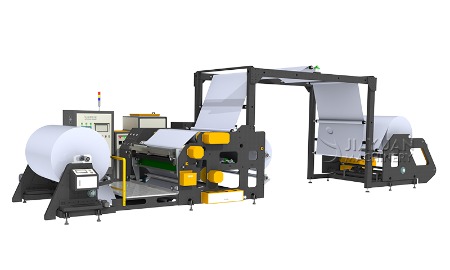
Adhesive coating machine
Uniformity across the web is achieved through precise shim design and manifold engineering. The shim determines the slot gap distribution; any variation causes non-uniform flow. Shim thickness is chosen based on the target coat weight and viscosity; typical shims range from 0.1 to 1.0 mm. The shim also defines the coating width; edge tapers are often added to reduce edge bead. The manifold must compensate for pressure drop along the width due to wall friction; a well-designed manifold ensures that the flow rate per unit width is constant. Real-time thickness measurement (beta, X-ray, or optical) is integrated into a closed-loop control that adjusts the pump speed to correct deviations. For even higher precision, some dies have an array of thermal actuators that locally heat or cool the die body to fine-tune the gap distribution, enabling automatic profile correction. This active profile control can reduce thickness variation by up to 50% compared to passive dies.
One of the main advantages of slot die coating is the wide viscosity range—from 1 cP (watery) to over 100,000 cP (paste). For low-viscosity fluids, the vacuum level must be carefully set to avoid bead breakup; for high-viscosity, the pump pressure must be high enough to overcome the die resistance. The fluid delivery system includes a filter (to remove particles) and a degassing unit (to remove bubbles). Degassing is crucial for high-quality films, as bubbles cause pinholes. The pump is typically a gear pump with a servo motor for precise, pulse-free flow. A pressure sensor at the die inlet monitors the pressure; a sudden drop indicates filter clogging or pump failure. The pump speed is the master variable for coat weight; line speed is independently controlled, and their ratio determines the wet thickness. The web tension must be stable to maintain a constant die-to-web gap; any tension fluctuation changes the hydrodynamic pressure and affects coat weight.
Drying or curing downstream of the slot die must be matched to the coating. For solvent-based coatings, the oven's evaporation capacity must handle the solvent flow; for hot-melts, a chill roll solidifies the film; for UV-curable, a UV lamp bank is placed immediately after the die. The slot die itself is not involved in drying, but the coating's rheology changes with temperature, so die temperature control is important. Maintenance of slot dies is labor-intensive but essential. After each run, the die must be disassembled, and the internal channels flushed with solvent or cleaning solution. The shim must be inspected for flatness; any distortion is discarded. The die lips are gently polished if scratched. Reassembly requires precise torque on the bolts to avoid distorting the slot gap. Alignment between the two die halves must be checked with a dial gauge. Because of this complexity, many manufacturers maintain two dies—one in operation, one being cleaned—to reduce downtime. In high-volume production, automated die cleaning stations are becoming available. Slot die coating machines are the technology of choice for high-value applications like battery electrodes, optical films, OLED displays, and pharmaceutical patches, where uniformity is non-negotiable and any defect is costly. Their precision, repeatability, and material efficiency justify the higher investment and maintenance effort.