Slot Die Coating Machine: Process Window Mapping and Defect Elimination
Operating a slot die coating machine successfully requires a deep understanding of the "coating window"—the range of process parameters that yield a stable liquid bead and defect-free coating. The key parameters are web speed, pump flow rate (or wet thickness), die-to-web gap, vacuum level, fluid viscosity, surface tension, and die angle. The coating window is often depicted as a graph of flow rate vs. speed, bounded by four limiting phenomena: low-flow breakup (the bead tears due to insufficient liquid), high-flow dripping (excess liquid causes dripping), low-speed air entrainment (air is pulled into the bead because the web moves too slowly relative to the liquid), and high-speed hydrodynamic instability (the bead oscillates or breaks due to inertia). Within the window, the coating is uniform and stable. The width of this window depends on the fluid properties and die design; for a given fluid, operators must find the optimal combination to achieve the target coat weight at the desired speed. The window can be determined experimentally by performing a series of trials at varying speeds and flow rates while visually observing the bead and measuring thickness. Many advanced coaters have automated window-mapping routines that systematically probe the parameter space.
Defects in slot die coating are numerous and often related to bead instability. One common defect is "barring"—a periodic thickness variation that appears as transverse lines across the web. This is caused by a mechanical vibration or pressure pulsation. Barring can be mitigated by reducing pump pulsation (using a pulse dampener), increasing the die gap, or stiffening the machine frame. "Ribbing" is another defect: fine longitudinal streaks caused by non-uniform flow distribution across the width, often due to uneven shim gap or manifold design. Ribbing can be reduced by adjusting the die angle, increasing the vacuum, or using a shim with a more gradual entrance. "Air entrainment" results in bubbles or pinholes; it occurs when the gap is too large or the vacuum too low, allowing air to be dragged into the bead. Increasing vacuum or decreasing gap helps. Conversely, "dripping" occurs when the flow rate is too high relative to speed, causing the bead to overflow; reducing pump speed or increasing line speed solves it.
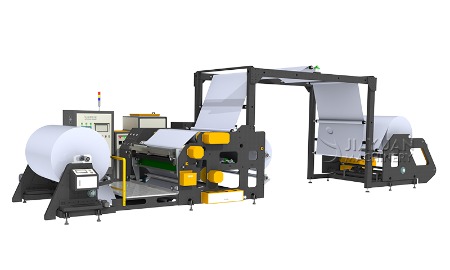
Adhesive coating machine
Edge bead is a persistent issue where the coating thickens at the web edges due to surface tension effects. Slot die can produce severe edge bead, which wastes material and causes problems in slitting. Solutions include using shims with tapered edge cuts, applying edge vacuum, or using a slight over-coating followed by edge trimming. Some dies have "edge deckles" that mechanically block flow at the edges. Another approach is to reduce the surface tension of the fluid by adding surfactant, but this may affect adhesion. The edge bead can be measured by a profilometer and adjusted in real-time if the die has edge actuators. For high-precision products, edge bead is often accepted and trimmed off, but the trimming width must be minimized to reduce waste. The trade-off between trimming width and coating window is a key optimization challenge.
Other defects include "mottle" (cloudy irregular patches) due to poor wetting or substrate contamination, and "crazing" (micro-cracks) from excessive drying stresses. Mottle is addressed by improving substrate pretreatment and ensuring the fluid has adequate surface tension lowering. Crazing requires adjusting the drying profile—reducing the ramp rate or adding a slow-drying zone. Also, "die lines" are permanent streaks caused by scratches on the die lip or foreign material lodged in the slot. Prevention involves meticulous cleaning and using high-quality filtration. If die lines appear, the die must be inspected and polished or the offending particle removed. Regular lip cleaning with a soft cloth and appropriate solvent is a daily routine.
To systematically eliminate defects, machine operators should maintain a defect log linking each defect type to the operating conditions at the time. Statistical analysis (Pareto charts, control charts) helps prioritize the most frequent issues. A structured approach—first check the die gap and shim, then verify pump calibration, then review vacuum and angle, and finally examine drying conditions—often resolves most problems. Collaboration with the fluid supplier is beneficial, as small adjustments in rheology can expand the coating window significantly. For example, increasing viscosity slightly can stabilize the bead at higher speeds. Conversely, reducing surface tension can improve wetting. The
slot die coating machine, with its inherent precision, rewards careful process development. Once a robust coating window is established and defects are eliminated, the machine delivers unparalleled consistency and low scrap rates, making it indispensable in modern converting and electronics industries. Continuous training and process audit are recommended to maintain this performance over time.