Solvent Adhesive Coating Machine: Engineering for Safety and Emission Control
Solvent adhesive coating machines are designed to handle adhesives dissolved in organic solvents such as toluene, acetone, ethyl acetate, or hexane. These machines are essential for producing high-performance tapes, labels, and membranes where water-based or hot-melt alternatives cannot meet the required durability, temperature resistance, or clarity. However, solvent-based processes pose significant safety and environmental challenges due to flammability, toxicity, and VOC emissions. Therefore, the engineering of these machines prioritizes explosion protection, fire suppression, and solvent recovery. All electrical components—motors, sensors, switches—must be explosion-proof (Ex-rated) and housed in purged enclosures. The coating area is continuously ventilated with a dilution air system that keeps solvent vapor concentration below 25% of the lower explosive limit (LEL). Gas detectors are placed at multiple points, and if LEL rises, the line automatically shuts down and inert gas (nitrogen) is injected into the oven and coating head.
The drying oven is the most critical component for solvent removal and emission control. It is typically a multi-pass, multi-zone convection oven with carefully controlled air flow and temperature. The oven is designed as a closed loop: exhaust air is passed through a solvent recovery system (carbon adsorption or thermal oxidizer), and a portion of the dried air is recirculated to conserve energy. The oven pressure must be slightly negative to prevent solvent leakage into the production area. Each zone has independent temperature control, with a profile that gradually increases to avoid surface blistering. The oven's air impingement velocity is tuned to the solvent's evaporation rate and the adhesive's film thickness. For high-boiling solvents, the final zone operates at higher temperatures to drive off residual. Oven cleaning is essential because condensed solvent or decomposed adhesive can create fire hazards; regular internal inspection and steam cleaning are recommended.
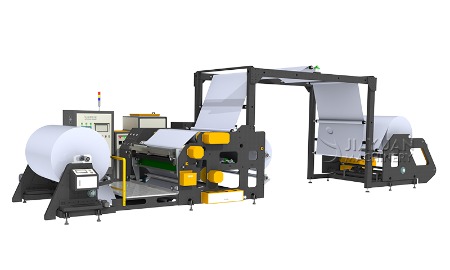
Adhesive coating machine
Solvent recovery is both an environmental mandate and an economic opportunity. Carbon adsorption systems use activated carbon beds to trap solvent vapors; the beds are regenerated with steam or hot nitrogen, and the recovered solvent is condensed for reuse. Thermal oxidizers combust the VOCs at 700-800°C, releasing heat that can be recovered to preheat oven air. For large lines, a combination of condensation and adsorption is used to achieve >99% recovery efficiency. The recovered solvent must be distilled to remove water and contaminants before returning to the mixing tank. The entire recovery system is monitored by continuous emission monitoring systems (CEMS) to comply with local air quality regulations. In many regions, solvent consumption taxes or credits are based on recovery rates, so optimizing recovery directly impacts operating costs. The machine's control system must balance oven exhaust rate, recovery unit capacity, and solvent loading to maintain steady state.
Fire suppression systems are mandatory. These include automatic sprinklers, CO2 or foam extinguishers, and heat/ flame detectors in the oven and coater hood. In case of fire, the line stops, all dampers close, and suppressant is discharged. Explosion vents are installed on the oven roof to release pressure if an ignition occurs. Operators must be trained in emergency response drills, including evacuation, and must wear flame-resistant clothing. Regular inspection of all safety devices—flame arrestors, pressure relief valves, and interlocks—is part of the maintenance schedule. Additionally, the machine must have a grounding system to prevent static charge buildup, which can ignite solvent vapors; static eliminator bars are placed near the web entry and exit. The substrate itself must be anti-static treated or conductive to dissipate charge. All these safety measures increase the machine's complexity and cost but are non-negotiable for solvent adhesive coating.
Despite these challenges, solvent-based coaters offer unparalleled performance: excellent adhesion to low-energy surfaces, high temperature resistance, and optical clarity. They are used for automotive tapes, electronics masking films, and aerospace composites. To remain competitive, modern solvent adhesive coaters are incorporating smart controls that optimize oven temperature based on real-time solvent concentration, reducing energy waste. Also, low-VOC solvent blends are being developed to lower emissions. The machine's mechanical design includes high-precision slot-dies with stainless steel construction to withstand solvent corrosion. Pumps are typically gear pumps with double mechanical seals to prevent leaks. All hoses and gaskets are solvent-resistant (PTFE or Viton). Maintenance procedures require thorough flushing with solvent after each batch to prevent gelling; this solvent flush is collected and sent to recovery. Changeover times are longer than other systems, so production scheduling must be optimized. In summary, the
solvent adhesive coating machine is a high-stakes investment that combines advanced safety engineering with precise process control to produce superior products while meeting stringent environmental standards.