Solvent Adhesive Coating Machine: Process Optimization for Acrylic and Rubber-Based Formulations
Solvent-based acrylic adhesives are widely used for their excellent weatherability, UV resistance, and long-term aging properties. They are typically supplied as high-molecular-weight polymers dissolved in aggressive solvents like ethyl acetate or toluene. Coating these adhesives requires careful control of viscosity, solid content (typically 30-50%), and drying conditions to achieve target peel and shear values. A common issue is "skin formation"—a dried surface layer that traps solvent underneath, leading to bubbles and poor adhesion. To avoid this, the oven's first zone is set at a moderate temperature (50-60°C) with low air velocity to allow slow surface drying, while subsequent zones increase to 100-120°C with high impingement to drive out the bulk solvent. The coating weight is directly proportional to the solid content and wet thickness; a 40% solids adhesive applied at 100 microns wet gives 40 microns dry. Precise pump calibration and die gap are essential. Acrylics also require crosslinkers (isocyanates or melamines) that activate during drying; the oven temperature must be high enough to initiate crosslinking but not so high as to degrade the polymer. Residual solvent must be below 0.5% for health and performance reasons; online solvent sensors (e.g., gas chromatography or NIR) can monitor residual levels.
Rubber-based solvent adhesives, often styrene-butadiene or natural rubber, are used for masking tapes and packaging. They have lower cost but are more sensitive to oxidation and require antioxidants in the formulation. Rubber adhesives have higher molecular weight and thus higher viscosity at the same solid content; they may need dilution with additional solvent or heating to reduce viscosity. Their drying profile is similar to acrylics but they are more prone to "edge bead" due to high surface tension. To mitigate, operators can use edge masking or reduce the die gap at the edges. Rubber adhesives also exhibit "cold flow" (creep) under pressure, so coat weight must be tightly controlled to avoid oozing. The pump pressure must be stable; pulsation dampeners are often installed. Also, rubber-based adhesives tend to build up more quickly on the die lip, requiring more frequent cleaning. Some formulations include tackifiers (resin esters) that lower the softening point, so the oven temperature must be carefully chosen to avoid softening the adhesive before it is cooled.
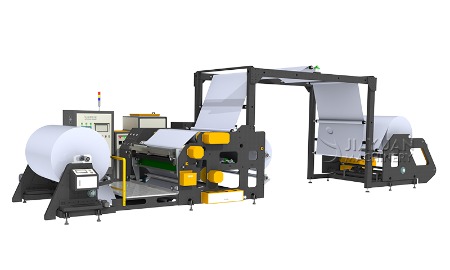
Adhesive coating machine
Optimizing the coating weight for both acrylic and rubber systems involves designing experiments (DoE) that vary line speed, pump rate, and die gap while measuring peel, tack, and shear. Typically, higher coat weight increases peel but may reduce shear due to cohesive failure. The optimal range is found by balancing these properties. Inline thickness gauges (beta or X-ray) provide continuous feedback; operators adjust pump speed to correct deviations. For solvent-based coaters, the relationship between wet and dry thickness is non-linear due to solvent evaporation and possible swelling; therefore, a calibration curve for each formulation is needed. The drying oven's air flow rate and temperature distribution can be mapped using anemometers and thermocouple arrays to ensure uniformity. Any hot spots or dead zones cause uneven drying, leading to wrinkled or tacky areas. Regular oven balancing—adjusting dampers and fan speeds—is part of process optimization.
Waste reduction is another optimization focus. Solvent-based coating lines generate significant solvent losses during cleanup and edge trim. Implementing a closed-loop solvent washing system that recycles rinse solvent can cut fresh solvent usage by 30%. Also, edge trims with adhesive can be dissolved and reprocessed if not crosslinked. The recovery unit's efficiency must be maintained; carbon beds require periodic replacement or reactivation. Many plants use a two-stage recovery: first a condenser to recover high-boiling solvents, then carbon adsorption for the remainder. Real-time monitoring of the recovery unit's inlet and outlet VOC levels helps detect breakthrough and schedule regeneration. Energy optimization is achieved by using heat exchangers to transfer heat from oven exhaust to incoming fresh air, reducing fuel consumption.
Operator expertise is a vital part of optimization. Experienced operators can interpret subtle signs: a slight change in peel gloss may indicate drying temperature drift; a haze on the film suggests solvent entrapment. They also maintain logs of viscosity, density, and solid content measured daily with a hydrometer or refractometer. When a formulation change occurs, they adjust the pump flow and die gap accordingly. Training programs that include hands-on troubleshooting and root-cause analysis empower operators to make informed decisions. Moreover, digital twin software that simulates the coating process allows off-line testing of new recipes without risking production. This reduces trial runs and accelerates new product development. In conclusion,
solvent adhesive coating machines require a holistic optimization approach integrating mechanical settings, thermal profiles, and material characterization to achieve high-quality, consistent products while minimizing cost and environmental impact.