Spray Coating Machine: Atomization Technologies and Coating Quality Control
Spray coating is a versatile technique where a liquid coating is broken into fine droplets by atomization and propelled towards a substrate. The droplets coalesce on the surface to form a continuous film. Spray coating machines are used in automotive, aerospace, medical device, and electronics industries for applying paints, varnishes, corrosion inhibitors, and biocompatible coatings. The main advantage is the ability to coat irregularly shaped substrates with complex geometries, which is difficult with roll or slot dies. Spray coaters can operate in continuous or batch modes, with substrate movement (conveyor) or robotic arm manipulation. The key challenge is achieving uniform film thickness while minimizing overspray (droplets that miss the target) and material waste. The coating quality depends on droplet size distribution, spray pattern, substrate speed, and drying conditions. Modern spray machines incorporate closed-loop control to maintain consistent parameters.
There are several atomization technologies. Airless spray uses high hydraulic pressure (up to 300 bar) to force fluid through a small orifice, producing fine droplets. It is efficient for high-viscosity coatings and high-speed applications, but droplet size is less controllable. Air-assisted spray combines fluid pressure with compressed air to break up droplets, offering finer atomization and better pattern control. Electrostatic spray charges the droplets electrically, causing them to be attracted to grounded substrates, drastically reducing overspray and improving transfer efficiency (up to 90%). Ultrasonic spray uses high-frequency vibrations to generate a fine mist with very narrow droplet size distribution, ideal for thin, uniform coatings on delicate substrates like sensors or solar cells. The choice of technology depends on the coating's viscosity, required thickness, substrate geometry, and environmental regulations. For solvent-based coatings, electrostatic spray is preferred to reduce VOC emissions. For water-based, air-assisted or ultrasonic are common.
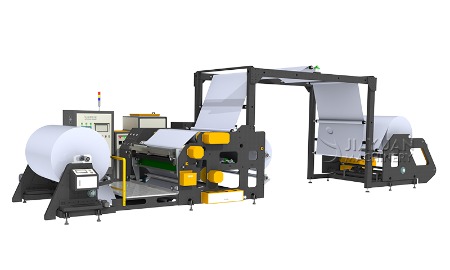
Adhesive coating machine
Droplet size is the most critical parameter; it determines the film smoothness, coverage, and drying behavior. Larger droplets (50-100 µm) create thicker films with orange peel, while smaller droplets (10-30 µm) produce smoother, thinner films but may dry before reaching the substrate, resulting in a powdery deposit. The droplet size distribution is measured by laser diffraction or phase Doppler anemometry. In practice, the spray pressure, air flow rate, and fluid viscosity are the primary controls. Higher pressure reduces droplet size, but may cause atomization instability. Fluid viscosity must be kept constant with temperature control; heaters or coolers are integrated into the supply system. The spray nozzle must be chosen with the appropriate orifice diameter and air cap design. Nozzle wear increases droplet size; regular inspection and replacement are necessary. Some machines have on-line droplet size monitors that provide feedback to adjust pressure automatically, maintaining consistent atomization.
Overspray is a major source of waste and environmental concern. It can be minimized by using electrostatic attraction, optimizing the spray gun position and angle, and using a shroud or exhaust hood to capture overspray. The captured overspray can be recycled in some systems (especially powder coatings), but for liquid coatings, it is usually disposed of. To improve transfer efficiency, the spray pattern should be tailored to the substrate shape; robotic systems with multiple axes can precisely follow contours, reducing overspray. Also, the distance between the gun and substrate (standoff distance) must be optimized; too close causes runs, too far increases overspray. Typical standoff distances are 150-300 mm. The gun traverse speed and overlap must be set to ensure full coverage without excessive coating. Online thickness gauges (e.g., laser triangulation) can provide feedback to adjust the gun's flow rate and traverse speed in real-time, maintaining uniform thickness across the part.
Drying and curing are integral parts of spray coating. Since sprayed films are often thin, they can flash off quickly, but the substrate may be large and require forced air or IR heating. The drying rate must be controlled to avoid solvent trapping (blisters) or surface defects. For reactive coatings (epoxy, polyurethane), the pot life is limited, so the spray system must be flushed regularly with solvent or cleaning solution to prevent gelation. The spray booth must be ventilated to remove solvent vapors and maintain a safe working environment. Fire suppression systems and explosion-proof electricals are mandatory for solvent-based sprays. Water-based sprays require corrosion-resistant materials in the fluid path. Maintenance of spray coaters involves cleaning nozzles, filters, and fluid lines daily; replacing seals and gaskets weekly; and calibrating pressure transducers and flow meters monthly. In summary,
spray coating machines offer unmatched flexibility for coating complex shapes, but they demand careful optimization of atomization parameters, overspray control, and drying to achieve high quality and efficiency. With proper automation and monitoring, they can be a reliable and cost-effective coating solution for many industries.