Spray Coating Machine: Nozzle Design, Maintenance, and Defect Prevention
The spray nozzle is the heart of any spray coating system. It converts fluid under pressure into a spray pattern of controlled shape and droplet size. Nozzles are classified by the atomization method: hydraulic (pressure only), air-assisted, or ultrasonic. Common spray patterns include flat fan, full cone, hollow cone, and round. Flat fan is most common for coating flat substrates, producing an elliptical footprint that can be overlapped to achieve uniform coverage. Full cone patterns are used for cylindrical or irregular surfaces. The nozzle's orifice size, swirl chamber, and air cap design determine the flow rate and droplet spectrum. For a given fluid, the nozzle must be sized so that the desired flow rate is achieved within the recommended pressure range (e.g., 20-80 bar for airless). Operating outside this range causes poor atomization or excessive wear. Many nozzles are made of hardened stainless steel, tungsten carbide, or ceramic to resist abrasive fluids. The choice of material affects longevity; ceramic nozzles last longer but are more expensive. Nozzle wear is a gradual process that increases orifice diameter, leading to higher flow rates and larger droplets. Regular flow checks using a graduated container and stopwatch can detect wear; if flow increases by 10%, replace the nozzle.
Spray pattern quality is affected by the nozzle's internal condition. Clogging from dried paint or foreign particles is the most common issue. To prevent clogging, install a 100-mesh or finer filter just before the nozzle. Also, use a solvent flush or purge cycle after each shutdown. If the nozzle does clog, it should be removed and soaked in an appropriate solvent, then gently cleaned with a soft brush or ultrasonic cleaner. Never use a metal pin or wire to poke the orifice, as this will damage the delicate geometry. For air-assisted nozzles, check the air cap for dried paint; clean it with a solvent-dampened cloth. The air cap's holes must be clear; a clogged air hole disrupts the spray pattern, causing tails or uneven edges. Regular inspection of the spray pattern on a test panel is recommended; a distorted pattern indicates nozzle damage or wear. Pattern testing should be performed daily, and the results logged.
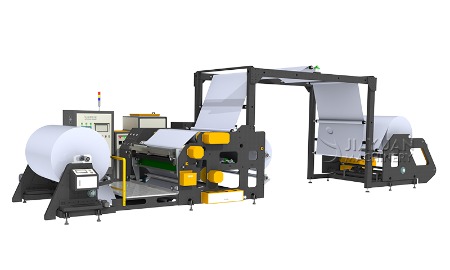
Adhesive coating machine
Defects in spray coating are often nozzle-related. "Runs and sags" occur when excessive coating is applied, causing gravity to pull the liquid downward. This is due to too high flow rate, too slow traverse speed, or standoff distance too short. Reduce flow rate, increase speed, or increase distance. "Dry spray" (powdery or rough surface) happens when droplets dry before reaching the substrate, due to low humidity, high air temperature, or excessive standoff distance. Add a slow-evaporating solvent, humidify the booth, or reduce distance. "Mottling" (uneven color or gloss) arises from overlapping spray passes inconsistently; ensure consistent overlap (typically 50%) and uniform traverse speed. "Orange peel" is caused by droplets that are too large or insufficient flow; reduce fluid viscosity or increase atomization pressure. "Pinholes" result from solvent bubbles escaping during drying; reduce film thickness or adjust drying profile. All these defects can be mitigated by systematic adjustment of spray parameters and regular nozzle maintenance. A defect logbook helps correlate issues with specific settings, enabling faster resolution.
Nozzle maintenance also includes checking and replacing the needle and seat in airless spray guns. These components control the on/off function. If they wear, the gun may drool or fail to shut off completely, causing drips on the substrate. O-rings and seals in the fluid path must be replaced periodically; swelling or hardening indicates incompatibility with the solvent. For electrostatic spray systems, the charging electrode must be kept clean and free of paint buildup, as contamination reduces charge efficiency and transfer efficiency. Some modern nozzles have integrated sensors that monitor flow rate and pressure, providing real-time diagnostics. This enables predictive maintenance; for example, a gradual pressure increase at constant flow indicates filter clogging or nozzle wear. Training operators on nozzle care and pattern inspection is essential; they should know how to interpret spray patterns and make minor adjustments without engineering help. By following a disciplined maintenance routine,
spray coating machines can produce high-quality, defect-free coatings consistently, reducing rework and material waste. Ultimately, the spray nozzle, though small, has a huge impact on the overall coating process economics and product quality.