Tape Coating Machine: Troubleshooting Common Defects and Quality Assurance
Tape coating is a demanding process, and defects can arise from various sources: the adhesive formulation, the coating head, the drying/curing, or the lamination. One common defect is "adhesive transfer" where the adhesive does not stay on the backing but instead transfers to the release liner or to the backside of the tape. This is often due to insufficient adhesion between the adhesive and the backing, which may be caused by low surface energy of the backing or contamination. The solution is to increase the corona treatment level, clean the backing, or use a primer. Another defect is "edge ooze" where the adhesive squeezes out at the edges of the tape, causing the rolls to stick together. This is due to excessive coat weight or high nip pressure; reducing the coat weight or nip pressure solves it. "Poor peel adhesion" (the tape does not stick strongly) is often due to low coat weight, under-drying (incomplete crosslinking), or incorrect adhesive formulation. The coat weight should be checked with a beta gauge; if it is low, the pump speed is increased. The drying temperature should be verified; if under-dried, the oven temperature is raised or the speed reduced. "Shear failure" (the tape slips or falls off under load) is caused by low internal strength of the adhesive, which may result from low coat weight, over-drying (brittleness), or improper crosslinker amount. The solution is to adjust the formulation or the coat weight. "Liner release failure" occurs when the release liner does not peel off cleanly; it may be due to high release force, adhesive migrating into the liner, or liner contamination. Replacing the liner with a lower-release type or adjusting the lamination pressure may help. "Wrinkling" during coating is caused by uneven tension; improving tension control and using a spreader roll eliminates wrinkles. "Blocking" is the sticking of the adhesive to the backside of the tape during winding; it is prevented by applying a low-adhesion backsize (LAB) coating to the backside of the backing or by using a release liner. The LAB coating is applied by a separate gravure station before the PSA coating.
Quality assurance for tape coating involves a battery of tests. The most common are: peel adhesion (measured by a tensile tester peeling the tape from a standard steel panel at 180° or 90°), loop tack (measured by the force required to peel a loop of tape from a panel), and shear adhesion (measured by the time or load to slide a tape from a panel under static load). These tests are performed on samples taken from the beginning, middle, and end of each roll. The results must fall within the specification limits. Additional tests include: thickness (by micrometer or gauge), width, color, and optical clarity. For double-sided tapes, the release force of the liner is measured. The quality control lab should be equipped with standard test equipment and follow ASTM or ISO standards. The test data is recorded in a quality database and used for statistical process control (SPC). If a test fails, the cause is investigated, and the process is adjusted. The corrective action is documented. In some cases, the tape may be reworked (e.g., by re-laminating with a new liner) if possible. The customer may also perform incoming quality inspections; the supplier must provide a certificate of compliance. In summary,
tape coating machines require rigorous quality assurance to ensure that the tape meets the performance and appearance requirements. By understanding the common defects and their causes, and by implementing systematic testing and corrective actions, manufacturers can produce consistent, reliable tapes that satisfy their customers' needs.
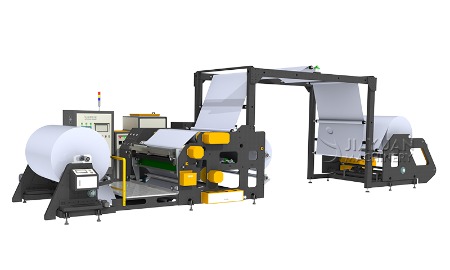
Adhesive coating machine
Advanced quality control includes inline inspection of the coated tape for defects such as streaks, bubbles, and gel particles. Line-scan cameras with appropriate lighting can detect these defects in real-time; the defective sections are automatically flagged or rejected. The inspection system can also measure the width and edge straightness. The data from the inline inspection is used to adjust the coating process; for example, if a streak is detected, the operator can clean the die lip immediately. The combination of inline inspection and off-line lab testing provides comprehensive quality coverage. The tape coating line may also have a "process capability" requirement; for example, a Cpk > 1.67 for coat weight. This ensures that the process is highly capable and produces minimal defects. Regular audits of the quality system are performed to maintain certification. Training operators on quality testing and troubleshooting is essential; they are the first line of defense against defects. In conclusion, achieving high-quality tape coating is a continuous effort that involves process optimization, defect prevention, and rigorous testing. With a disciplined approach, tape coating machines can produce millions of square meters of high-performance tape with minimal waste and maximum customer satisfaction.