Textile Coating Machine: Defect Troubleshooting, Quality Assurance, and Innovations
Defects in textile coating can ruin the fabric's appearance and function. Streaks are linear defects caused by a damaged blade, a particle trapped under the blade, or non-uniform coating supply. Cleaning the blade and filtering the coating material solves this. Pinholing—small holes in the coating—is due to air bubbles or low surface energy of the fabric. Degassing the coating and increasing the surface energy (via corona or plasma) prevents pinholing. Uneven coating across the width is caused by non-uniform blade pressure or a worn backing roll; adjusting the blade and regrinding the roll corrects it. Skips (uncoated spots) occur when the fabric is not in contact with the blade due to wrinkles; proper tension and a spreader roll prevent wrinkles. Blistering during curing is caused by trapped solvent or water; reducing the oven temperature ramp rate allows the solvent to escape slowly. Poor adhesion of the coating to the fabric is due to low fabric surface energy or contamination; washing, corona treatment, or using a primer solves it. Stiffness of the coated fabric is caused by excessive coat weight or over-curing; reducing the coat weight or lowering the curing temperature gives a softer hand. A systematic troubleshooting method: define the defect, check the blade and roll, measure the coat weight, verify the oven temperature, test the fabric's surface energy, and adjust the parameters. Preventive maintenance includes regular blade sharpening, roll cleaning, and sensor calibration. The defect log helps track recurring issues. Operators should be trained to identify and correct defects early, minimizing waste.
Quality assurance for coated textiles involves testing both the coating and the fabric. The coat weight is measured by taking samples and weighing them after drying. The adhesion strength is tested by peeling the coating from the fabric (90° peel test); the force must be within the specification. The abrasion resistance is tested by rubbing the coated fabric with a standard abrader (Martindale or Taber). The waterproofness is measured by a hydrostatic pressure test; the fabric must withstand a certain water column pressure. The breathability is measured by MVTR; the coating must allow moisture vapor to pass. The flame retardancy is tested by a vertical flame test; the fabric must self-extinguish. The coating's flexibility is tested by bending the fabric repeatedly; no cracking should occur. The aging resistance is tested by exposing the fabric to heat, humidity, and UV; the properties should not degrade significantly. All tests follow ISO, EN, or ASTM standards. The quality data is recorded and analyzed. If a test fails, the process is investigated. For example, if the adhesion is low, the fabric's surface treatment or the coating's curing might be the cause. The corrective action is documented. The quality management system ensures traceability; each batch of fabric and coating is logged. In summary, comprehensive quality assurance ensures that the coated textile meets its intended functional and safety requirements, providing confidence to the end-user.
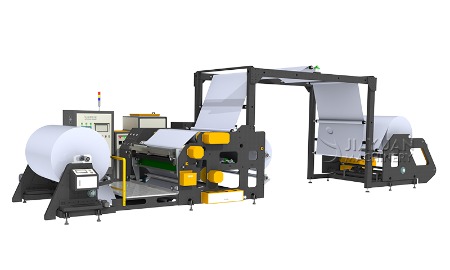
Adhesive coating machine
Innovations in textile coating are driven by sustainability and new functionalities. Water-based polyurethane (PU) coatings are replacing solvent-based PU to reduce VOC emissions; they require longer drying times and special drying ovens, but they are safer and more environmentally friendly. Bio-based coatings made from plant oils and starches are emerging; they are biodegradable and have lower carbon footprints. Smart coatings that respond to stimuli (temperature, pH, light) are being developed for medical and protective textiles; these coatings incorporate microcapsules or conductive polymers. The coating machine must be adapted to apply these new materials; for example, smart coatings may require low shear and precise temperature control. The use of plasma treatment to activate the fabric surface before coating is increasing; it improves adhesion and allows lower coat weights. Digital coating (inkjet) is being explored for pattern coating with minimal waste, but it is currently limited to low coat weights. The trend towards recyclable textiles requires the coating to be separable or compatible with the fabric's recycling stream. Coating machine manufacturers are developing modular and flexible systems that can handle different coating methods and materials with quick changeovers. The integration of Industry 4.0 sensors and analytics is optimizing the coating process in real-time, reducing defects and energy consumption. In conclusion, textile coating is advancing towards greater sustainability, functionality, and efficiency, and coating machines are evolving to meet these new challenges, enabling the production of high-performance, eco-friendly fabrics for a wide range of applications.