Textile Coating Machine: Systems for Functional Fabrics, Protective Textiles, and Technical Textiles
Textile coating is a process that applies a layer of polymer or compound onto the surface of a fabric to modify its properties. Coated textiles are used in outdoor clothing (waterproof/breathable), industrial fabrics (tarpaulins, conveyor belts), protective clothing (flame retardant, chemical resistant), and automotive interiors. The coating can be applied as a continuous film or as a discontinuous pattern. The coating weight typically ranges from 10 to 500 gsm, depending on the application. The coating machine must handle a wide range of fabric weights (50-600 gsm) and widths (up to 3 meters). The fabric is delicate and can stretch; tension control must be gentle. The most common coating methods are: knife-over-roll (doctor blade), roll coating (rotary screen or pad), slot-die, and foam coating. Knife-over-roll is the most versatile for thick coatings (50-500 gsm); it uses a blade that presses against a backing roll, spreading the coating liquid. Roll coating applies a film using a set of rolls; it is used for thinner coatings (10-100 gsm). Slot-die offers precision for thin, uniform coatings (10-200 gsm). Foam coating applies a foamed compound that penetrates the fabric for core effects. The choice of method depends on the coating material's viscosity and the desired finish. The coating machine is typically a stand-alone unit or integrated into a finishing line. It includes an unwinder, the coating head, a drying/curing oven, and a rewinder. The drying oven is often a tenter frame that holds the fabric at the edges to prevent shrinkage.
The coating materials used in textile coating are diverse. PVC (polyvinyl chloride) is used for heavy-duty waterproofing (tarpaulins, truck covers); it is applied as a plastisol (dispersion of PVC in plasticizer) and cured by heat. Polyurethane (PU) is used for breathable waterproof coatings (for outdoor apparel); it can be solvent-based or water-based. Acrylic polymers are used for soft finishes, flame retardant coatings, and backcoatings. Silicone is used for high-temperature and release coatings. The coating material is often a viscous liquid or paste; it is pumped from a supply tank to the coating head. The coating head must be temperature-controlled for some materials (e.g., PVC plastisol is applied at 20-30°C, but cured at 150-200°C). The drying/curing oven is typically a hot air tunnel with multiple zones; the temperature profile is set to remove solvent or water and to crosslink the polymer. For PVC, the oven is long (20-40 meters) to allow full fusion. For water-based PU, the oven is also long to evaporate water. The fabric's heat sensitivity limits the maximum oven temperature. The machine must have a high-speed rewinder for the finished fabric. The coating line often includes a knife-over-roll coater with adjustable blade pressure; the coat weight is controlled by the blade gap and the pressure. The fabric's speed is typically 5-50 m/min, slower than paper or film coating due to the heavier coating and the oven length. The machine's control system monitors temperature, speed, and coat weight. The coating head must be cleaned regularly to prevent buildup of dried compound.
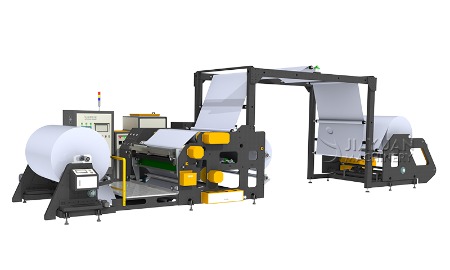
Adhesive coating machine
Process control for textile coating is challenging due to the fabric's porosity and stretch. The coat weight must be uniform; variations cause stiff or weak spots. The coat weight is measured by weighing samples or using an online beta gauge (for heavy coatings). The blade gap is set by feeler gauges or by a motorized system. The fabric tension is controlled by dancer rolls and load cells; too much tension can stretch the fabric, changing its width. The oven's air flow must be gentle to avoid fabric fluttering; an air flotation system can be used. The curing temperature must be accurate; under-curing results in tacky or weak coating; over-curing can cause brittleness and discoloration. The coating material's viscosity must be stable; temperature control and mixing are essential. The machine must have a cleaning-in-place (CIP) system for the coating head and the supply lines. The quality of the coated textile is tested for adhesion (peel strength), abrasion resistance, waterproofness (hydrostatic pressure), breathability (MVTR), and flame retardancy. The test results are used to adjust the process parameters. In summary,
textile coating machines are robust, versatile systems that require careful control of coating weight, drying, and curing to produce high-quality functional fabrics for a wide range of applications.