Transfer Adhesive Coating: Principles, Process Design, and Applications in PSA Tapes and Labels
Transfer adhesive coating, also known as indirect coating, is a two-step process that decouples the coating step from the final substrate bonding. In the first step, a liquid adhesive—typically a pressure-sensitive adhesive (PSA) such as acrylic, rubber, or silicone—is coated onto a temporary carrier, which is a release liner (siliconized paper or film). The adhesive is then dried or cured to form a solid, tacky layer. In the second step, this coated liner is laminated to the permanent substrate (face stock) using a laminating nip, and the liner is subsequently peeled away, leaving the adhesive firmly attached to the face stock. This method is widely used for double-sided tapes, transfer tapes (where the adhesive layer itself is the final product), and labels. The primary advantage of transfer coating is that it allows the adhesive to be fully dried or cured before contact with the final substrate, protecting heat-sensitive or delicate materials from the high temperatures and tensions of the coating and drying process. It also enables independent optimization of the adhesive coating and the substrate lamination, improving overall quality. The release liner must have a controlled release force—typically 5-20 g/in—to allow clean transfer without damaging the adhesive. The coating method used on the liner can be slot-die, gravure, or roll, with slot-die preferred for its precision and uniform coat weight. The line includes an unwinder for the liner, the coating head, a drying oven (or cooling section for hot-melts), a laminating station, and a rewinder for the finished product.
The process design of a transfer coating line requires careful coordination between the adhesive coating and the laminating sections. The adhesive coat weight on the liner must match the final required thickness on the face stock, as no additional adhesive is added during lamination. Typical coat weights range from 10 to 50 gsm for PSA tapes. The drying or curing profile must be optimized to ensure complete removal of solvents (for water/solvent-based adhesives) or proper solidification (for hot-melts) without degrading the liner's silicone release coating. The liner's temperature should be monitored; excessive heat can soften silicone and cause sticking. After drying, the coated liner is often cooled before lamination. The laminating nip consists of a steel and a rubber roll; the pressure must be sufficient to ensure intimate contact and air displacement, but not so high as to squeeze out the adhesive. The face stock unwinder provides the permanent substrate, which may be film, paper, foam, or nonwoven. Edge guides align the two webs to avoid offset. The laminating speed must match the coating line speed; any mismatch causes tension variations. The liner is then rewound separately (if it is to be removed later) or kept on the product (for liner-protected tapes). The entire process is controlled by a PLC that synchronizes the drives and maintains tension. Transfer coating allows the production of very thin and uniform adhesive layers, making it ideal for optical clear adhesives and medical tapes where precision is paramount. It also reduces waste because the coating quality can be inspected on the liner before lamination, allowing defective sections to be rejected without wasting the face stock.
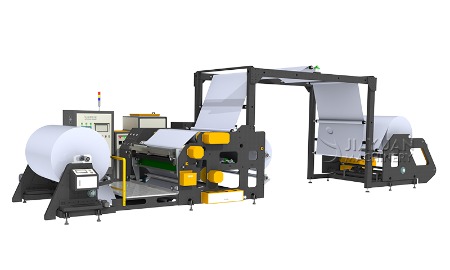
Adhesive coating machine
Critical process parameters in
transfer adhesive coating include coat weight, release force, drying temperature, laminating pressure, and web tensions. The coat weight must be uniform to ensure consistent adhesive performance; online beta or X-ray gauges provide feedback to the pump or die gap. The release force is determined by the silicone chemistry and the coat weight of the silicone; it must be stable; any variation causes transfer failure (adhesive sticks to the liner) or poor peel. The drying oven has multiple temperature zones; the first zone is set lower to avoid skinning, followed by higher temperatures for bulk evaporation. The laminating nip pressure is typically 20-50 N/mm; it must be uniform across the width. The web tensions are controlled independently: the liner tension is higher to prevent sagging, while the face stock tension is lower to avoid stretching. The control system maintains these parameters and provides alarms if any deviates. The quality of the transfer adhesive product is tested by peel adhesion (to steel or the face stock), tack (loop tack), and shear (static or dynamic). The transfer efficiency—the fraction of adhesive that transfers from the liner—should be near 100%; if lower, the release force is too high or the face stock surface energy is too low. Surface treatment (corona, plasma) of the face stock may be needed to ensure complete transfer.
Defects in transfer adhesive coating are often related to the liner or the lamination. "Transfer failure" occurs when the adhesive remains on the liner instead of transferring to the face stock; this is due to too high release force or incomplete curing. Adjusting the silicone formulation or increasing the lamination pressure solves it. "Air bubbles" trapped between the adhesive and the face stock are caused by insufficient nip pressure or rough face stock; increasing pressure or using a smoother face stock helps. "Adhesive ooze" is adhesive squeezing out at the edges; it is due to excessive nip pressure or coat weight; reducing pressure or coat weight prevents it. "Wrinkling" occurs if the two webs have different tensions; proper tension matching and using a spreader roll eliminate it. "Silicone transfer" (silicone migrating to the adhesive) is caused by under-cured silicone; increasing the curing temperature or time fixes it. A systematic troubleshooting approach includes: define the defect, inspect the liner and face stock, check the process parameters, test the release force, and adjust the nip or drying conditions. Preventive maintenance includes regular cleaning of the coating head, replacing the laminating nip rolls, and verifying the oven's temperature uniformity. Operators should be trained to monitor the quality and adjust settings. In summary, transfer adhesive coating is a versatile and precise method that enables the production of high-quality PSA products with excellent uniformity and performance. Its design and operation require careful attention to the liner's release, the adhesive's rheology, and the laminating conditions to achieve defect-free, reliable transfer.