Transfer Adhesive Coating: Process Optimization, Quality Assurance, and Advanced Applications
Optimizing the transfer adhesive coating process involves balancing multiple interdependent parameters: coat weight, drying temperature, laminating pressure, and line speed. A design of experiments (DOE) is the standard approach; factors such as coat weight (e.g., 20, 25, 30 gsm), drying temperature (80, 100, 120°C), and laminating pressure (20, 35, 50 N/mm) are varied systematically, and the resulting peel adhesion and transfer efficiency are measured. The response surface analysis identifies the optimal combination that maximizes peel strength and transfer while minimizing defects. For example, a DOE may show that a coat weight of 25 gsm, a drying temperature of 110°C, and a laminating pressure of 40 N/mm give the best results. The optimized settings are stored as a recipe for each product. The line speed is then increased incrementally to find the maximum speed that maintains quality; this is often limited by the drying capacity. The use of a high-velocity impingement oven can increase the drying rate, allowing higher speeds. The optimization also includes minimizing waste; the diverting valve directs the first few meters of coating to waste until the parameters stabilize. The edge trim width is minimized by precise edge guidance and by using a slot-die with tapered shims. The changeover time between products is reduced by using quick-change coating heads and pre-cleaned components. The optimization is an ongoing process; the data from the quality control system is used to fine-tune the parameters. In summary, process optimization improves the efficiency and profitability of transfer adhesive coating, reducing waste and energy consumption while maintaining consistent adhesive performance.
Quality assurance for transfer adhesive coatings is comprehensive and includes both in-line and off-line testing. In-line, the coat weight is monitored by an online gauge (beta or X-ray); the thickness variation should be less than ±2%. A line-scan camera inspects the coated liner for defects such as streaks, pinholes, and edge bead; any defect is flagged for rejection. After lamination, the finished product is inspected for bubbles, wrinkles, and adhesive ooze. Off-line, the peel adhesion is tested on a standard panel (e.g., stainless steel) using a tensile tester; the force must be within the specification. The tack is measured by a loop tack test. The shear adhesion is measured by applying a static load to a sample and recording the time to failure. The release force from the liner is measured; it must be within the specified range. The adhesive's aging stability is tested by exposing samples to heat (e.g., 70°C for 7 days) and humidity (e.g., 90% RH) and then re-testing the adhesion. The quality data is recorded and analyzed using SPC; if a trend is detected, the process is investigated. The quality management system ensures traceability; each batch of adhesive, liner, and face stock is logged. In summary, quality assurance ensures that the transfer adhesive product meets the performance and reliability requirements of its application, whether it is a simple tape or a high-tech optical adhesive.
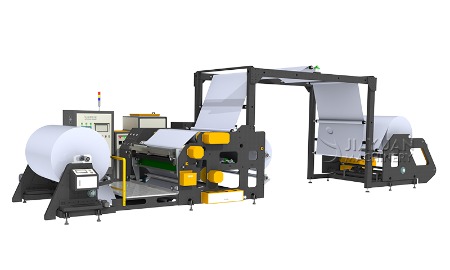
Adhesive coating machine
Advanced applications of
transfer adhesive coating include optical clear adhesives (OCAs) for display laminations and double-sided medical tapes. OCAs require extremely uniform coat weight (typically 25-50 µm) with no optical defects; they are coated on a PET release liner using a slot-die in a cleanroom environment. The transfer coating process allows the adhesive to be fully cured (often UV-cured) before lamination to the display glass, ensuring bubble-free lamination. The release liner must have a very smooth surface and a controlled release force to avoid distorting the adhesive. Double-sided medical tapes require a hypoallergenic adhesive coated on a release liner on both sides; the transfer process allows each adhesive layer to be optimized independently. The face stock is often a foam or nonwoven carrier; the laminating nip pressure must be low to avoid crushing the carrier. The adhesive must pass biocompatibility tests (ISO 10993). The transfer coating line for these advanced applications is designed with higher precision, cleaner environments, and more sophisticated control systems. The quality requirements are more stringent; for example, the coat weight variation for OCAs is typically ±0.5 gsm. The optimization of the process for these applications involves more complex DOEs and the use of advanced sensors (e.g., optical profilometers). In summary, transfer adhesive coating is a versatile platform that can be tailored to a wide range of applications, from commodity tapes to high-value optical and medical products, by careful selection of materials, precise process control, and rigorous quality assurance.