Transfer Coater: Principles of Indirect Coating and Applications in PSA Tapes
Transfer coating is a two-step process: coating a release liner with an adhesive, drying/curing, and then laminating that adhesive layer onto a permanent substrate (face stock). This is widely used for pressure-sensitive adhesive (PSA) tapes, labels, and specialty films. The primary advantage is that the substrate never contacts the coating head or the oven, protecting delicate materials like foam, thin films, or low-heat plastics from mechanical stress and high temperatures. It also allows the adhesive to be fully dried/cured before it is combined with the face stock, ensuring consistent properties. The release liner is typically a siliconized paper or film that has low surface energy so the adhesive releases cleanly. The transfer coater line includes an unwinder for the liner, a coating station (usually slot die, gravure, or comma coater), a drying oven or cooling zone, a laminating station where the face stock is applied, and a rewinder. The process can be run in-line (all steps continuous) or off-line (coating and laminating as separate operations). In-line is more efficient but requires precise tension and speed coordination between the two webs.
The coating step on the release liner is similar to direct coating, but the liner's release properties impose constraints. The liner must have adequate dimensional stability to prevent stretching, and its silicone coating must not transfer to the adhesive (silicone migration), which would reduce adhesion. The coat weight on the liner is exactly the same as the final adhesive thickness after transfer. For PSA tapes, typical coat weights are 10-50 gsm. The drying or curing must be complete so that no solvent or water remains that could cause blistering during lamination. For hot-melt PSAs, the adhesive is cooled on the liner; no drying is needed. The liner temperature during coating must be controlled; if the liner gets too hot, the silicone may soften and cause sticking. For solvent-based adhesives, the oven exhaust must be designed to remove solvents from the liner surface without causing condensation. After drying, the coated liner is often cooled before lamination to prevent thermal damage to the face stock.
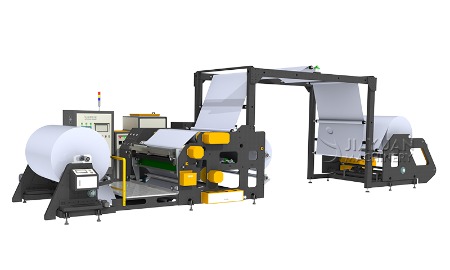
Adhesive coating machine
Lamination is the critical step where the adhesive is transferred from the liner to the face stock. This is done by pressing the coated liner and the face stock together between two rolls (lamination nip). The nip pressure, temperature, and roll hardness are adjusted to ensure complete transfer without trapping air bubbles. The pressure must be high enough to displace air and achieve intimate contact, but not so high that it squeezes adhesive sideways (causing ooze). The lamination nip typically uses a rubber-backed steel roll. For very sensitive face stocks (e.g., foam), a soft roll with low pressure is used. After lamination, the liner is separated from the adhesive layer; the adhesive adheres to the face stock because it has higher affinity to the face stock than to the liner. The liner is then rewound as a waste product or reused if it is a durable film. The face stock with adhesive is wound into a finished roll. In some applications, the liner is kept on the tape as a protective backing and removed by the end user—this is common for double-sided tapes. In that case, the lamination step is omitted, and the coated liner itself is the final product (transfer tape).
Advantages of transfer coating include the ability to coat thin, delicate substrates that cannot withstand the tension or heat of a coating line; the ability to pre-inspect the adhesive coating before lamination, reducing waste; and the flexibility to use different face stocks with the same pre-coated liner, enabling quick product changeovers. Disadvantages are the extra cost of the release liner, the need for a laminating station, and potential adhesion issues if the liner's release level is too high (the adhesive doesn't transfer) or too low (the adhesive sticks to the liner). The release level is measured by the "release force" in grams per inch; for most PSAs, a release force of 5-20 g/in is optimal. The liner material and silicone coating must be chosen to match the adhesive chemistry; for acrylic PSAs, a solvent-resistant liner is needed; for water-based, a liner with good dimensional stability in humid conditions is important. The liner may also be primed with a tie coat to improve release consistency.
Process control in transfer coating focuses on maintaining the coat weight on the liner, the lamination nip conditions, and the tension difference between the liner and face stock. The coated liner tension must be slightly higher than the face stock tension to prevent wrinkles. The laminating station should include an edge guide to align the two webs. Online inspection of the adhesive layer before lamination using a camera can detect defects early. The drying oven must be long enough for the adhesive to be fully set; under-dried adhesive will offset (transfer to the backside of the liner during winding). Also, static electricity can attract dust; anti-static bars are used. The rewinder for the final product must handle the thick material (liner + adhesive + face stock) with variable diameter. In summary, transfer coating is a versatile and protective method for producing high-quality adhesive tapes. It decouples coating from final substrate handling, enabling the use of heat-sensitive and fragile materials, and offers process flexibility. With careful selection of liner, optimization of lamination, and robust control,
transfer coaters deliver consistent, defect-free PSA products for diverse industries, from packaging to medical applications.