Transfer Coater: Release Liner Selection, Lamination Optimization, and Defect Prevention
The release liner is a critical consumable in transfer coating. It must provide a controlled release force—high enough to keep the adhesive intact during coating and drying, but low enough to allow clean transfer to the face stock. Liners are typically made of paper (supercalendered) or polymer films (PET, polypropylene), coated with a silicone release agent. The release force is determined by the silicone chemistry (platinum-cured, tin-cured, or UV-cured) and the coat weight of silicone. For solvent-based acrylics, a platinum-cured silicone with a release force of 10-15 g/in is common; for rubber-based hot-melts, a release force of 5-10 g/in may suffice. The liner must have a smooth surface to ensure the adhesive film is defect-free; any texture on the liner will emboss onto the adhesive. The liner's thickness and stiffness affect handling; thinner liners are more economical but prone to wrinkling. For high-temperature drying, the liner must withstand the oven temperature without shrinking or blistering; PET liners can withstand up to 150°C, while paper liners are limited to about 120°C. The liner should also be anti-static treated to prevent dust attraction. Suppliers often provide release level data and shelf-life information; it is advisable to test the liner with the specific adhesive before production.
Lamination optimization involves controlling the nip pressure, temperature, and speed. The nip pressure is typically 20-60 N/mm, depending on the face stock thickness and compressibility. For delicate foams, use low pressure to avoid crushing. The nip rolls must be parallel; misalignment causes uneven transfer and wrinkles. The roll temperature can be heated (e.g., 40-60°C) to soften the adhesive, improving wetting onto the face stock, but excessive heat may degrade the adhesive or face stock. For cold adhesives (water-based after drying), room temperature lamination is common. The speed of lamination must match the line speed; any speed mismatch causes tension changes and may induce folds. Some transfer coaters have a "nip time" control—the dwell time of the web in the nip—which is inversely proportional to speed. For thick adhesives, a longer dwell time helps complete transfer. The lamination station should have a rubber-covered steel roll with a hardness of Shore A 70-90; softer rolls conform better to uneven surfaces but may have shorter life.
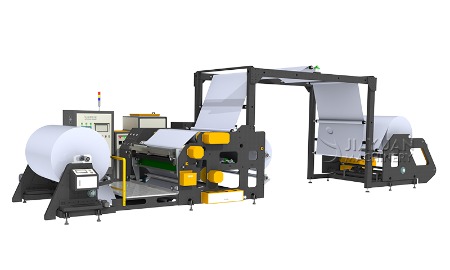
Adhesive coating machine
Air bubbles are a common defect in transfer coating, appearing as small spherical voids between the adhesive and the face stock. They arise from trapped air in the nip or from outgassing of the adhesive. To prevent air bubbles, ensure the nip rolls are clean and the face stock is free of dust. Use a slightly higher nip pressure to squeeze out air. For porous face stocks (e.g., paper), the air escapes naturally; for non-porous films, a vacuum assist or a rubber nip with a microscopically rough surface helps. Also, the lamination should be done with a slight angle (e.g., 20-30 degrees) between the two webs entering the nip, which helps air escape. If bubbles persist, the adhesive may be gassing due to residual solvent; increase drying time or temperature. Some coaters use a "hot nip" where the rolls are heated to promote adhesive flow, which closes air voids. Regular inspection with a light table or optical sensor detects bubbles early; the line can be stopped and the cause identified before large quantities are wasted.
Transfer failure occurs when the adhesive does not release from the liner and instead stays on it. This is caused by release force too high (overly aggressive silicone) or by adhesive crosslinking that bonds to the liner. Solutions: select a liner with lower release force, or add a release agent to the adhesive. If the failure is localized, it may be due to a silicone coating defect on the liner (e.g., a missed spot). Also, the adhesive may be too tacky at lamination; cooling the adhesive before lamination reduces tack and aids release. For hot-melt adhesives, ensure the adhesive is sufficiently cooled below its softening point before lamination. If the liner is reused, the release properties degrade; replace liners according to supplier recommendations. Another cause is insufficient nip pressure; increase pressure or use a softer nip roll to improve contact. Also, contamination on the face stock (e.g., oils) can prevent adhesion; clean the face stock with a solvent or corona treat it.
Wrinkling and ooze are other defects. Wrinkling occurs when the two webs have differential tension or when the face stock is wider than the liner, causing folds. Ensure both webs have controlled, matched tensions; use a dancer roll to equalize. The web guides must align the edges accurately. Ooze is adhesive squeezed out from the edges of the laminate, which can soil equipment and cause blocking during winding. Ooze results from excessive nip pressure or too high adhesive flow at the edges. Reduce nip pressure, or use edge dams to confine the adhesive. Also, ensure the face stock width is slightly wider than the adhesive coated width to allow for any expansion. If ooze persists, reduce the adhesive coat weight or increase its viscosity. After lamination, the finished roll should be wound with a starting tape to prevent adhesive from contacting the backside. By methodically addressing these defects through liner selection, nip optimization, and web handling,
transfer coaters can produce clean, bubble-free laminates with high yield. Continuous training and documentation of successful parameter sets for each product are essential for consistent quality.