Troubleshooting Pressure Sensitive Adhesive Coating Lines: From Defects to Solutions
Despite careful design, pressure sensitive adhesive coating lines encounter a variety of defects that affect product performance and appearance. One frequent problem is adhesion failure: the tape does not stick properly or peels off prematurely. This can originate from insufficient coat weight, improper crosslinking, or contamination of the adhesive surface. Insufficient coat weight reduces contact area; operators must verify that the pump flow rate matches the line speed and that the die gap is correct. Crosslinking (for acrylic PSAs) requires proper oven temperature and residence time; under-cured adhesive is weak. Contamination can come from silicone oils used in release liners—if the liner bleeds, the PSA surface gets contaminated. Monitoring silicone transfer via contact angle measurements and adjusting liner formulation or using a barrier layer is necessary. Also, substrate surface energy must be high enough; corona or plasma treatment should be checked daily with dyne pens.
Another common defect is cohesive splitting, where the adhesive layer tears internally instead of releasing from the substrate. This occurs when the internal strength (cohesion) is lower than the adhesion to the substrate. Causes include excessive coating thickness, over-drying (brittleness), or using an incorrect crosslinker amount. The solution is to adjust the formulation or reduce coat weight. In production, regular peel tests (90-degree or 180-degree) and shear tests (static or dynamic) monitor these properties. If cohesive failure appears, immediate batch verification and possible rework are required. Die buildup is a persistent issue in PSA coating—dried adhesive accumulates at the die lip or roll edges, eventually breaking off and causing streaks or gel particles. This is mitigated by frequent wiping with solvent-soaked cloths, using anti-die build additives (e.g., Teflon coatings), and optimizing die temperature to reduce evaporation at the lip. Automated lip cleaning systems that periodically sweep the edge can also help, but they must not introduce contaminants.
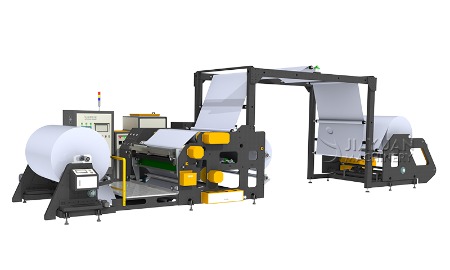
Adhesive coating machine
Streaks and mottling are visual defects that render the tape unacceptable for transparent or high-gloss applications. Streaks often arise from die lip damage, clogged shim lanes, or inconsistent pump flow. A thorough inspection of the die lip with a magnifying glass may reveal nicks or burrs; these can be polished out if shallow, or the lip must be reground. Clogged lanes require disassembling the die and flushing with solvent. Mottling (irregular cloud-like patterns) is typically due to poor flow distribution in the manifold or fluctuating viscosity. CFD analysis of the die design can identify flow imbalances; adjusting the manifold or changing the shim thickness distribution may resolve it. Also, the adhesive's rheology—specifically its shear-thinning behavior—must be matched to the die geometry; otherwise, flow instabilities occur. On-line optical inspection systems can detect streaks and mottling early, allowing operators to stop and correct before large quantities are wasted.
Edge bead and adhesive ooze at the substrate edges cause problems in slitting and converting. Edge bead is thicker coating at the edges, which can be trimmed off, but that adds waste. Adjusting the shim edge taper, using edge masking tape, or applying vacuum to the edges helps. Adhesive ooze occurs when the adhesive flows beyond the substrate edge, contaminating rolls and equipment. Proper die alignment and maintaining a slightly narrower coating width than the substrate width prevents ooze. Some coaters use edge nozzles to apply a thin stream of solvent to reduce edge bead. Another issue is blocking during winding—the adhesive sticks to the backside of the substrate. This requires applying a release coating on the backside or using a release liner. If blocking occurs, the winding tension may be too high; reducing it and using a larger core can help. Also, the adhesive must be fully dried or cooled before winding; residual tackiness indicates incomplete drying or cooling.
Quality assurance in PSA coating involves destructive and non-destructive testing. Destructive tests include peel adhesion (to stainless steel or standard panels), loop tack, and shear hold. These are performed on samples cut from the roll at defined intervals. Non-destructive tests use online thickness gauges and line-scan cameras to monitor coat weight and defects continuously. Statistical process control charts track key parameters like average coat weight, standard deviation, and defect counts per 10,000 square meters. When a parameter exceeds control limits, an alarm prompts immediate investigation. Root cause analysis using fishbone diagrams helps identify whether the issue is material, machine, method, or environment. For example, sudden increase in streaks might be due to a new batch of adhesive with higher filler content, or a worn pump seal causing pulsation. Documented troubleshooting guides and operator training enable quick response. By systematically addressing each defect with a clear action plan, PSA coating lines can maintain high yields (often >95%) and deliver reliable, consistent products for the demanding pressure-sensitive tape market.