Types of Adhesive Coaters: Selection Criteria and Application Ranges
Adhesive coaters are the core equipment in converting industries, classified primarily by their coating head design. The major categories are roll coaters, gravure coaters, slot-die coaters, curtain coaters, and knife-over-roll coaters. Each type has distinct advantages and limitations, making them suitable for specific adhesive formulations, substrate materials, and production volumes. Roll coaters are the simplest and most cost-effective, using a series of rolls to transfer adhesive from a pan to the substrate. They can handle both solvent-based and water-based adhesives, but coat weight control is less precise, typically ±5% of target. They are ideal for general-purpose tapes, masking tapes, and paper lamination where tight tolerances are not critical. Gravure coaters, on the other hand, use an engraved cylinder that picks up adhesive from a bath and wipes excess with a doctor blade. They excel at low coat weights (1-10 gsm) and high speeds, making them popular for thin PSA applications like release liners and label stock. However, pattern marks from the engraved cells may be visible, limiting aesthetic applications.
Slot-die coaters are closed-system, pre-metered heads that deliver adhesive through a precision slot directly onto the web. They offer outstanding uniformity (±1%), minimal solvent emissions, and wide viscosity range (from 100 cP to over 100,000 cP). This makes them the top choice for high-value optical adhesives, battery electrode binders, and silicone release coatings. The downside is higher capital cost, complex cleaning, and sensitivity to gap adjustments. Curtain coaters apply adhesive as a free-falling liquid curtain, used for thick coatings on wide substrates like floor coverings or textile backing. They handle high flow rates but are prone to air entrainment. Knife-over-roll coaters use a doctoring blade to meter the adhesive on a substrate supported by a roll; they are robust for high-viscosity pastes and heavy coat weights, common in roof membranes and carpet adhesives. Selection depends on coat weight range, line speed, adhesive rheology, and required uniformity.
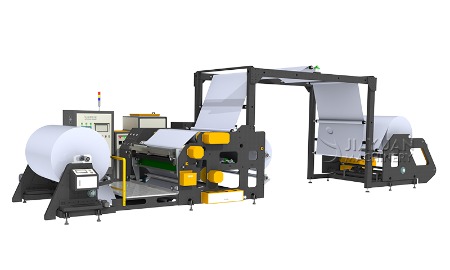
Adhesive coating machine
When selecting an adhesive coater, one must also consider the upstream and downstream processes. The unwinder must handle the substrate roll weight and diameter, with tension control suitable for sensitive films or foams. The oven or drying section must match the coater's speed and the solvent/water evaporation rate. For hot-melt adhesives, the coater is integrated with a melter unit that provides molten adhesive at a precise temperature, and no drying is needed—instead, a cooling section solidifies the coating. The rewinder must accommodate the finished roll with proper tension to avoid telescoping or crushing. Additionally, the floor space, utility requirements (electricity, compressed air, exhaust), and operator access for cleaning and maintenance are practical factors. Many coaters are modular, allowing future upgrades like adding a second coating head for multi-layer applications or installing a corona treater for improved substrate wetting.
Another critical selection criterion is the ability to handle different adhesive chemistries without cross-contamination. For example, a coater used for solvent-based acrylic PSA must be thoroughly cleaned before switching to silicone release coatings; otherwise, residual acrylic will cause release failure. Quick-change die systems, wash stations, and disposable liners can reduce changeover time. In high-mix production environments, coaters with quick-release doctor blades, removable pans, and programmable cleaning cycles are preferred. The control system should store recipes for each adhesive type, including temperature setpoints, pump speeds, and oven profiles, to ensure repeatability. Automated die gap adjustment and profile control are valuable features that improve consistency and reduce operator dependency. Finally, the supplier's technical support, availability of spare parts, and training programs should influence the decision, as proper maintenance and skilled operation are as important as the hardware itself.
Cost considerations include not only the initial purchase price but also operational costs: energy consumption, adhesive waste, cleaning solvent usage, and maintenance frequency. Slot-die coaters have higher upfront cost but lower waste, making them economical for expensive adhesives. Gravure coaters have moderate cost but require periodic cylinder re-engraving, which is a recurring expense. Roll coaters have low initial cost but may waste more adhesive due to pan evaporation and cleanup. For startups or low-volume production, used or refurbished coaters can be a viable entry point. However, older machines may lack modern safety features (fire suppression, explosion-proof enclosures) and precise controls. A thorough cost-benefit analysis, considering production volumes, adhesive costs, and quality requirements, is essential before purchase. Additionally, future scalability should be assessed—will the coater handle higher speeds or wider webs if demand grows?
In summary, the
adhesive coater landscape offers diverse options, and there is no universal "best" type. The optimal choice aligns with the specific product requirements, budget, and operational philosophy. Consultation with coating engineers and running trial samples on different coater types are recommended before finalizing. Many suppliers offer pilot coating facilities where customers can test their adhesives and substrates. These trials reveal actual performance data on uniformity, defect rates, and drying efficiency. They also help operators become familiar with the machine interface and maintenance routines. In the long run, investing in a well-matched adhesive coater reduces rejects, enhances productivity, and ensures consistent product quality, thereby strengthening the manufacturer's competitive position in the market.