Unwind Tension Control: Strategies for Consistent Back Tension and Splice Management
The unwinder is the first module of a coating line, and its primary function is to feed the web at a consistent tension. The unwinding roll starts with a large diameter and gradually decreases as the web is consumed. To maintain a constant tension, the braking torque must be reduced proportionally to the roll diameter: torque = tension × radius. If the torque is not adjusted, the tension will increase as the diameter decreases, leading to excessive tension at the core. Therefore, the control system must continuously calculate the roll diameter and adjust the brake torque. The diameter is calculated from the line speed and the roll's rotational speed: D = (2 × V) / (π × ω), where V is the line speed and ω is the rotational speed. This calculation requires a precise speed sensor on the unwinder and a reliable tachometer. The brake can be mechanical (pneumatic disc or drum), which is simple and cost-effective, but has slower response. More commonly, electric brakes (eddy current or regenerative) are used for their fast response and precise control. The brake is controlled by a PID loop that uses the tension sensor (load cell) as feedback. The loop adjusts the brake current or air pressure to maintain the setpoint. The unwinder also has a dancer roll (a position-based sensor) that provides a mechanical buffer; the dancer's position is used as a secondary feedback, and the brake is adjusted to keep the dancer in its mid-position. This dual-loop control provides robust tension control even during speed changes.
The unwinder must also handle splices—the joining of a new roll to the old one. During a splice, the web is temporarily stopped or slowed, and the tension can drop or spike. To manage this, the unwinder typically has a festoon accumulator that stores enough web to allow the line to continue running at full speed while the splice is made. The festoon has a dancer that moves; when a splice is detected, the dancer moves to release web, and the brake is adjusted to maintain tension. After the splice, the dancer returns to its normal position. The control system must have a fast response to these transients; the PID gains may be tuned to handle the dynamic load. The splice itself is a point of weakness; the tension should be reduced slightly during the splice to avoid breaking the taped joint. This is done by a "splice tension" setpoint, which is a lower tension that is active for a few seconds. The operator programs this into the recipe. After the splice passes through the coating head, the tension returns to normal. If the splice is not properly joined, it can cause a web break; therefore, the splice tape must be strong and the web tension must not exceed the tape's strength. Many lines have a splice detection sensor (e.g., a photoelectric or ultrasonic sensor) that triggers the tension reduction. In summary,
unwind tension control is a dynamic process that must accommodate changing roll diameter, speed changes, and splices. Proper control ensures that the web is fed smoothly and consistently to the coating section, minimizing defects and downtime.
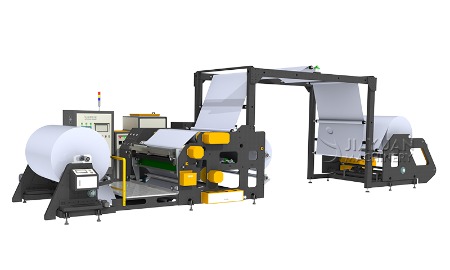
Adhesive coating machine
The selection of the unwinder type depends on the roll weight and the required tension range. For light rolls (up to 100 kg), a simple shaftless unwinder with a mechanical brake may suffice. For heavy rolls (over 1000 kg), a turret unwinder with two roll positions is used; it allows automatic splicing without stopping the line. The turret rotates to bring a new roll into position while the current roll is finishing. The splice is made automatically by a splicing unit that uses a hot melt or adhesive tape to join the webs. The tension during the transfer must be precisely controlled; a "flying splice" is common, where the new roll is accelerated to match the line speed before contact. The acceleration is controlled by a motor on the new roll; once the speeds match, a nip roller presses the new web to the old, and the old web is cut. This requires precise synchronization and tension control. The control system must have a splice sequence programmed, with setpoints for acceleration, tension, and timing. The entire operation is automated, reducing operator intervention and ensuring consistent splices. The unwinder's control system also includes safety features: if the tension exceeds a limit, the brake is released to prevent a web break; if the web breaks, the line stops and an alarm sounds. In summary, unwind tension control is a specialized area that combines mechanical design, drive technology, and automation. With modern turret unwinders and advanced control algorithms, the web can be fed continuously at a stable tension, enabling high-speed coating with minimal waste.