Unwind Tension: Impact on Web Quality, Telescoping, and Coating Start-Up
The unwinding roll is a wound package of substrate; if the tension during unwinding is too high, it can cause the layers to stick together (blocking), especially if the substrate has a coating on the backside. If the tension is too low, the layers may shift sideways, causing telescoping. Both defects ruin the roll and may cause web breaks. The ideal unwind tension is the minimum tension required to keep the web taut without deforming the roll. For a given roll, the tension should be set based on the substrate's stiffness and the roll's width. A common guideline is to use a tension of 5-15% of the substrate's tensile strength. For example, for a 50 N/cm tensile strength, the tension would be 2.5-7.5 N/cm. The roll's hardness should be checked; if the roll is too soft, it may not provide enough back tension; if it is too hard, it may cause blocking. The unwinder's brake should be adjusted to provide a smooth, steady tension; any pulsation from the brake can cause thickness variations in the coating. The tension should be monitored during the entire run; if the tension gradually increases, it may indicate a problem with the brake or the diameter calculation. The control system should have a "tension profile" feature that allows the operator to set a taper: the tension is reduced slightly as the roll diameter decreases, to compensate for the reduced roll stiffness. The taper factor is typically 10-20%. This reduces the risk of blocking near the core.
Start-up is a critical time for unwind tension. When the line starts, the unwinder must accelerate from zero to the operating speed. If the brake is not released quickly, the tension will spike, causing a web break. Therefore, the start-up sequence includes a "tension build-up" phase: the brake torque is ramped up gradually from zero to the setpoint over a few seconds, while the dancer roll provides a buffer. The speed of the unwinder is controlled by a torque profile that matches the line acceleration. The control system uses a "soft start" algorithm that limits the acceleration rate to avoid excessive tension. The operator can set the acceleration rate in the recipe; a typical rate is 1-2 m/s². During start-up, the web is often run at a reduced speed until the tension is stabilized, then the speed is increased to the operating speed. This reduces the risk of defects. Similarly, during shutdown, the tension is ramped down gradually to avoid slackness. The start-up phase should be monitored; any deviation from the setpoint should trigger an alarm. Proper start-up procedures are essential for minimizing waste and ensuring a smooth transition to steady-state production.
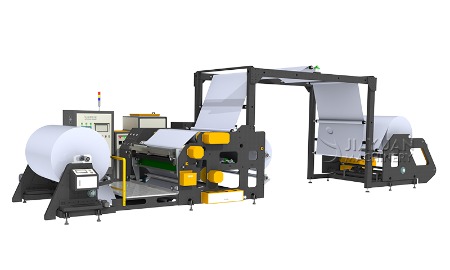
Adhesive coating machine
The unwinder's brake must be regularly maintained. The brake pads (for mechanical brakes) wear out over time, causing inconsistent tension. The wear should be inspected and replaced as needed. For electric brakes, the cooling system must be functioning; if the brake overheats, its performance degrades. The bearings of the unwinding shaft must be lubricated; if they are worn, the roll may wobble, causing tension fluctuations. The roll's core (the cardboard or plastic tube) must be in good condition; a damaged core can cause eccentricity, leading to periodic tension variations. The operator should check the core before loading the roll. The roll's weight must be within the unwinder's capacity; overloading can strain the bearings and the brake. In summary,
unwind tension is not just a process parameter but also a maintenance concern. By ensuring the unwinder is in good mechanical condition and the tension setpoints are appropriate for the substrate, the coating line can achieve high uptime and consistent quality. The cost of a web break is high, so investing in proper unwind tension control pays off quickly.
Troubleshooting unwind tension issues: If the tension is too high, check the brake torque calibration, the diameter calculation, and the roll's stiffness. If the tension is too low, check for air leaks in pneumatic brakes, or for a worn brake pad. If the tension oscillates, check for a damaged core, a bent shaft, or a faulty brake controller. If the tension drops during a splice, check the splice sequence parameters and the festoon's capacity. If the web breaks at the unwinder, reduce the acceleration rate or increase the tension setpoint slightly (if the substrate allows). Maintaining a log of unwind tension settings for each product helps to quickly set up for repeat runs. In conclusion, unwind tension is a key parameter that affects both the coating process and the quality of the unwinding roll. With careful selection, monitoring, and maintenance, it can be controlled to ensure smooth, reliable operation, minimizing waste and maximizing productivity.