Viscosity Range: Impact on Coating Method Selection, Equipment Design, and Process Control
The selection of a coating method is largely dictated by the fluid's viscosity at the processing temperature. Gravure coating is suitable for low-viscosity fluids (1-100 cP) because the cells fill by capillary action; at higher viscosities, the cells do not fill completely, leading to a lower and non-uniform coat weight. Spray coating is limited to <1000 cP for air-assisted spray and up to 5000 cP for airless, because higher viscosities require excessive atomization pressure and cause nozzle wear. Roll coating (two-roll, three-roll) works well for medium viscosity (50-5000 cP); for higher viscosities, the rolls must be heated to reduce viscosity, or the speed ratio adjusted. Reverse roll coating can handle up to 50,000 cP with proper design. Slot-die coating is the most versatile, covering 1-100,000 cP, but the die gap and manifold design must be optimized for the specific viscosity: high viscosity requires a wider slot gap (e.g., 0.5-1.0 mm) and a lower land length to reduce pressure drop; low viscosity requires a narrow gap (0.1-0.3 mm) to maintain a stable bead. Comma coating (or knife-over-roll) is designed for high-viscosity pastes (10,000-200,000 cP) where the fluid has a yield stress; it can apply thick layers. Hot-melt coating is used for thermoplastics that are solid at room temperature but become low-viscosity when heated (e.g., 50-500 cP at 150°C). Therefore, the viscosity range is the first filter in method selection. If the viscosity is too high for the chosen method, the fluid must be diluted, heated, or modified with additives. If it is too low, it may require a thickener or a lower temperature. In practice, the fluid's viscosity is often adjusted during formulation to fit the available coating equipment.
Equipment design is directly influenced by viscosity. For pumping, the pump type and size must match the viscosity and the required flow rate. Gear pumps are common for medium to high viscosity because they provide a positive displacement and are pulse-free; they are available in various sizes and materials (stainless steel, hardened). For very high viscosity (>100,000 cP), a screw pump or a piston pump is used. For low viscosity, a centrifugal pump may be used, but it is less accurate. The pump's motor power must be sufficient to overcome the pressure drop, which increases with viscosity. For slot-die, the pressure drop across the die is approximately proportional to viscosity × flow rate / gap³. Therefore, for high viscosity, the die gap must be larger, or the die length shorter, to keep the pressure within the pump's capability and to prevent die deflection. The die material must be rigid enough to withstand the pressure without bending. The die's internal manifold must be designed to distribute the flow uniformly at the given viscosity; for high viscosity, the manifold must have a larger cross-section to avoid excessive pressure gradient across the width. The heater or cooler system must be sized to maintain the fluid at the target temperature, because viscosity changes by about 5-10% per °C for many polymers. The piping and hoses must have adequate diameter to keep the pressure drop low and to allow easy cleaning. All these design aspects are determined by the
viscosity range. Therefore, when procuring a coating line, the supplier must know the fluid's viscosity to provide a suitable design.
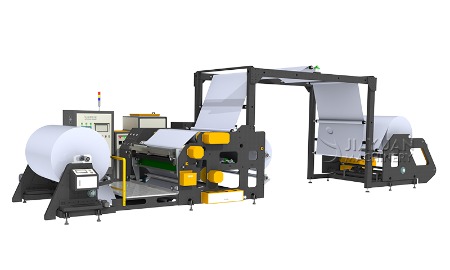
Adhesive coating machine
Process control must compensate for viscosity fluctuations that occur during production. Viscosity can drift due to temperature changes (from the oven or ambient), solvent evaporation from open pans, or batch-to-batch raw material variations. The control system can respond in several ways. First, temperature control: the tank, hoses, and die are equipped with heaters or coolers that maintain the fluid at a setpoint; a PID controller adjusts the heating/cooling to compensate for external disturbances. If the viscosity deviates, the temperature can be adjusted to bring it back to the target (within the material's thermal stability limits). Second, the pump speed can be adjusted: if the viscosity increases, the pump will need more torque to deliver the same flow; a pressure sensor at the die inlet can detect the pressure rise and, if the viscosity change is known, the pump speed can be reduced slightly to maintain the same coat weight (since flow = pump speed × displacement, and the displacement is independent of viscosity). However, this only works if the pressure- flow relationship is linear; for non-Newtonian fluids, it is not. Third, the die gap can be adjusted: for slot-die, increasing the gap reduces the pressure drop and allows operation at the same flow rate with higher viscosity; but this changes the coat weight, so the pump speed must be adjusted accordingly. In practice, the most common strategy is to keep the temperature stable and to use a feedback control loop that measures the coat weight and adjusts the pump speed; this loop inherently compensates for viscosity changes because the coat weight is the controlled variable. The viscosity measurement itself is not required for the loop; only the coat weight gauge is needed. However, knowing the viscosity is useful for diagnostics: if the pump speed has to change significantly to maintain coat weight, it indicates a viscosity change that may require attention (e.g., adding solvent or adjusting temperature). Therefore, many lines include an inline viscometer for monitoring and alarming.
Practical guidelines for managing viscosity range include: (1) Measure the viscosity of each batch before production and adjust the process parameters (pump speed, temperature) accordingly; (2) Maintain the fluid temperature within ±1°C to minimize viscosity drift; (3) For open pans, use a lid to reduce evaporation and add make-up solvent automatically; (4) For shear-thinning fluids, ensure that the shear history is consistent (e.g., same pump speed and pipeline length) to avoid batch-to-batch variation; (5) When changing to a different fluid with a different viscosity, adjust the die gap and pump calibration; (6) Use a pulse dampener to smooth out flow variations caused by viscosity-induced pressure oscillations; (7) Train operators to recognize the symptoms of viscosity change (e.g., change in motor current, pressure reading) and to take corrective action; (8) Keep a viscosity log to track trends and detect formulation problems. By following these practices, coating lines can handle a wide range of viscosities with good stability and quality. The viscosity range of the fluid is not a static specification; it can be tailored by the formulator and by the process engineer working together. The goal is to find the viscosity that provides the best balance of coatability, leveling, drying, and final performance. In summary, viscosity range is a foundational parameter that drives the choice of coating method, the design of equipment, and the control strategy. A thorough understanding of its effects enables efficient and robust coating production across diverse applications.