Viscosity Range in Coating Fluids: Measurement, Effect on Coatability, and Rheological Additives
Viscosity, defined as the resistance of a fluid to flow, is a key rheological property that profoundly influences the coating process. It affects the pumping requirements, the pressure drop in the die, the stability of the coating bead, the leveling of the film, and the transfer efficiency. The viscosity of coating fluids can span several orders of magnitude, from water-like (1-10 cP) to heavy pastes (over 100,000 cP). Each coating method is designed for a specific viscosity window. Gravure coating operates best with low-viscosity fluids, typically 10-100 cP, because the fluid must readily fill the small engraved cells and be easily doctored. Slot-die coating is extremely versatile, handling 1-100,000 cP, but the die design and pump selection must be matched; for high-viscosity fluids, a larger slot gap and higher pump pressure are needed. Roll coating can handle 50-50,000 cP; higher viscosities cause high drag and may require heated rolls. Spray coating is limited to low-to-medium viscosity (typically <1000 cP) for proper atomization; higher viscosities require airless or heated spray. Comma coating and knife-over-roll coating are designed for high-viscosity pastes (10,000-200,000 cP) such as battery slurries. Therefore, knowing the viscosity range is essential for selecting the right coating method and equipment. The viscosity is also temperature-dependent; for many fluids, a 10°C increase can halve the viscosity. Thus, temperature control is critical to maintain a stable viscosity during production.
Measurement of viscosity is performed using various instruments. The most common is the rotational viscometer (Brookfield type), which measures the torque required to rotate a spindle at a constant speed in the fluid. It gives a single viscosity value at a given shear rate, which is suitable for Newtonian fluids. For non-Newtonian fluids (shear-thinning or shear-thickening), the viscosity depends on the shear rate; thus, a rheometer that can measure viscosity as a function of shear rate (flow curve) is needed. The coating process imposes a shear rate that depends on the gap and speed; for slot-die, the shear rate is approximately the web speed divided by the gap, typically 10,000-100,000 s⁻¹. Therefore, the viscosity at these high shear rates is what matters for flow in the slot and bead. Low-shear viscosity affects leveling and sagging. Therefore, rheological characterization should cover the entire shear rate range relevant to the process. Inline viscometers, such as vibrating fork or capillary types, can provide continuous viscosity measurement for feedback control. However, they are less common than offline lab instruments due to cost and maintenance. The viscosity data is used to adjust the process: if the viscosity is higher than expected, the pump pressure will be higher for the same flow; the control system may need to adjust the pump speed or the temperature. The solids fraction and the particle size distribution also affect viscosity; a high solids content increases viscosity, and small particles increase it more than large ones. Therefore, viscosity measurement is a proxy for fluid consistency and formulation quality.
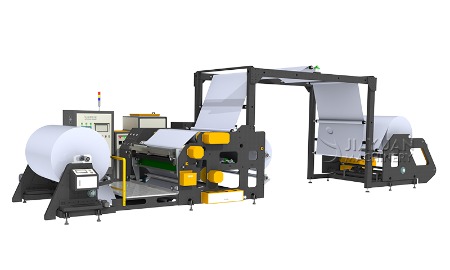
Adhesive coating machine
Rheological additives are used to adjust viscosity to the desired range and to modify the flow behavior. Thickeners (e.g., cellulose derivatives, polyacrylates) increase viscosity, which helps to prevent sagging and improves leveling by slowing down the flow. However, excessive thickening can cause flow marks and reduce wetting. Thinners (solvents, diluents) lower viscosity, which is useful for gravure or spray coating where low viscosity is required. Surfactants lower the surface tension and also affect the viscosity; they can be used to improve wetting. For non-Newtonian fluids, the shear-thinning behavior (viscosity decreases with increasing shear rate) is often desirable because it allows the fluid to be pumped easily at high shear (in the pump and die) but then to thicken after application to prevent sagging. This is achieved by adding high-molecular-weight polymers or using structured rheology modifiers. The selection of additives must be done carefully, as they can affect the coating's drying, adhesion, and final properties. The additive concentration is often small (0.1-5%), but its effect on viscosity can be dramatic. For example, adding 1% of a thickener can increase viscosity tenfold. Therefore, the formulation must be designed to work within the coating method's viscosity window. The rheological properties are also affected by aging, temperature, and shear history; the fluid may degrade or gel over time. Thus, the viscosity of the batch should be checked before production, and the process parameters adjusted accordingly. In some plants, a "viscosity adjustment" step is part of the batch preparation: the operator measures the viscosity and adds the necessary amount of solvent or thickener to bring it to the target.
The effect of viscosity on coating defects is significant. Low-viscosity fluids tend to cause more splashing, dripping, and misting, especially in roll and spray coaters. They also lead to poor leveling if the wet thickness is too low, resulting in orange peel. High-viscosity fluids can cause starved coating (if the pump cannot supply enough), air entrainment (if the fluid cannot wet the substrate quickly), and edge bead (due to high surface tension). They also require higher die pressures, which can cause die deflection and non-uniform gaps. The viscosity also affects the drying behavior; low-viscosity fluids have higher solvent content, which requires more drying energy. Therefore, the optimal viscosity is a compromise that balances the coating method's requirements and the product's needs. For slot-die coating, a viscosity of 100-10,000 cP is often considered the "sweet spot" because it provides good bead stability, moderate pressure drop, and acceptable leveling. For battery slurries, viscosities of 5,000-50,000 cP are common, and the shear-thinning behavior is crucial for coating. The viscosity also changes with the coating speed; as the speed increases, the effective shear rate increases, and if the fluid is shear-thinning, the viscosity drops, which can reduce the bead stability. Thus, the coating window must be defined with the correct viscosity at the operating shear rate. This requires a rheological model that fits the flow curve, such as the Power Law or Herschel-Bulkley model. The model parameters are used in the process control to predict the pressure drop and the bead stability. In summary,
viscosity range is a key specification for coating fluids, and its proper measurement, control, and adjustment are essential for a robust coating process. The use of rheological additives, coupled with accurate temperature control and in-line monitoring, enables coating lines to handle a wide variety of fluids while maintaining high quality and efficiency. Understanding the relationship between viscosity and coating performance is a fundamental skill for coating engineers, and it is the basis for troubleshooting many process problems.