Water Based Adhesive Coating Machine: Drying Dynamics and Corrosion Prevention
Water-based adhesive coating machines apply adhesives in which water is the primary carrier instead of organic solvents. These systems are favored for their low toxicity, non-flammability, and reduced environmental footprint. However, water has a high latent heat of vaporization (about 2257 kJ/kg) compared to solvents, requiring significantly more energy for drying. Moreover, water-based adhesives are often emulsions or dispersions of polymer particles (acrylic, vinyl acetate, styrene-butadiene) that need coalescence—the particles must fuse into a continuous film as water evaporates. This coalescence process is temperature- and humidity-dependent; if drying is too fast, a skin forms that prevents water escape, resulting in cloudy or weak films. Conversely, too slow drying reduces line speed and productivity. Therefore, the drying oven in a water-based adhesive coater is designed with longer length (often 30-50% longer than solvent ovens), multiple zones, and high-velocity air impingement to disrupt the boundary layer. Some ovens use infrared pre-heaters to elevate the substrate temperature quickly, promoting evaporation.
Humidity control is critical because water vapor concentration in the oven directly affects evaporation rate. If the oven's exhaust airflow is insufficient, the air becomes saturated, and drying stalls. Thus, modern water-based coaters include dew point sensors and modulate exhaust damper positions to maintain a constant vapor pressure deficit. In humid climates, dehumidification systems may be added to the incoming air. The oven's temperature profile typically starts with a low-temperature zone (40-60°C) to evaporate free water without boiling, followed by a high-temperature zone (80-120°C) for bound water and coalescence, and a final cooling zone to stabilize the film. The substrate must not exceed its heat deflection temperature; for PET film, this limits the max oven temperature to around 130°C. Real-time monitoring of web temperature using IR pyrometers helps avoid overheating. Additionally, the oven's airflow pattern must be uniform across the width; any turbulence can cause uneven drying, leading to differential gloss or adhesion.
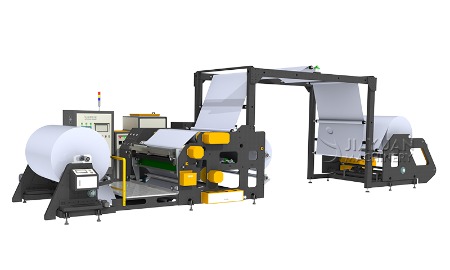
Adhesive coating machine
Corrosion prevention is a major concern because water and the acidic or alkaline additives in emulsions can attack machine components. All parts that contact the wet adhesive—tanks, pipes, pumps, coating heads, and even the oven interior—must be made of stainless steel (316L grade) or coated with corrosion-resistant materials. Carbon steel is unacceptable. The coating head, especially slot dies, requires passivation treatment to maintain a smooth surface. The backup rolls should have chrome plating or ceramic coatings. Regular cleaning with mild alkaline cleaners followed by thorough rinsing is necessary to remove dried polymer residues that can cause pitting. After each shutdown, the entire wet path must be flushed with water or a cleaning solution to prevent gel formation. The oven's condensate collection trays must drain quickly to avoid pooling, which leads to rust. Some machines use a nitrogen purge during idle periods to reduce moisture corrosion.
Another challenge with water-based adhesives is microbial growth. Emulsions often contain organic thickeners and surfactants that are nutrients for bacteria and fungi. Biocides are added, but if the machine is left idle, stagnant water can promote biofilm, which sloughs off and causes streaks. Therefore, a routine sanitization cycle using peroxide or chlorine-based cleaners is recommended. The supply tank should be jacketed to maintain temperature (typically 20-30°C) and equipped with gentle stirring to prevent sedimentation. Filtration must be fine (10-50 microns) but not so fine that it removes the emulsion particles. Filter housing should be easy to disassemble for cleaning. The pump selection for water-based adhesives is usually peristaltic or low-shear diaphragm pumps to avoid breaking the emulsion; gear pumps may cause high shear and flocculation.
Process control for water-based coaters is more complex than for solvent-based due to the slow evaporation and the influence of ambient humidity. Advanced control systems use a cascade structure: the line speed sets the required drying capacity; the oven temperatures and airflow are adjusted accordingly. Feed-forward control based on incoming substrate moisture content (measured by NIR) can pre-adjust oven settings. Coat weight feedback from beta gauges is used to trim pump speed. The laminating station, if present, must apply uniform pressure to embed any release liner. Since water-based adhesives have lower tack than solvent-based at equivalent coat weight, they often require higher coat weights (e.g., 20-40 gsm dry vs. 10-20 gsm for solvent-based) to achieve similar adhesion, which further stresses drying. To offset this, some lines use a two-stage coating (primer + topcoat) to reduce coat weight per pass. Despite the challenges, water-based adhesive coating machines are becoming the norm for many applications like labels, packaging, and construction tapes, driven by strict VOC regulations. Proper design, diligent maintenance, and intelligent control enable these machines to produce high-quality, eco-friendly adhesive products with competitive economics.