Water Based Adhesive Coating Machine: Formulation Compatibility and Coating Quality
The success of a water-based adhesive coating machine depends heavily on the compatibility between the adhesive formulation and the machine's hardware and process conditions. Water-based adhesives are complex mixtures of polymer dispersions, water, thickeners, surfactants, defoamers, coalescing agents, and crosslinkers. Each component affects rheology, surface tension, and drying behavior. The machine must handle varying pH levels (typically 4-9) and solid contents (30-60%). High solid content emulsions are more viscous but require less drying; however, they may be prone to shear thinning or thickening. The coating head must be selected based on the viscosity: slot-die works well for 500-5000 cP, while gravure is better for lower viscosity (<500 cP). For very high viscosity pastes (>10000 cP), roll coating with a heated applicator may be used to reduce viscosity. The pump must not induce excessive shear, which could destabilize the emulsion and cause coagulation. Progressive cavity pumps are often chosen for their gentle handling.
Coalescence is a unique aspect of water-based adhesives. As water evaporates, the polymer particles pack together and, with the help of coalescing agents (glycol ethers), deform and fuse into a continuous film. The coalescence temperature (minimum film formation temperature, MFFT) must be below the oven's operating temperature; otherwise, the film remains powdery and non-adhesive. Therefore, the adhesive supplier provides MFFT data; the machine operator must ensure the web temperature reaches at least 5-10°C above MFFT during drying. Additives like plasticizers can lower MFFT but may affect hardness. The drying profile must allow sufficient time for coalescence; too rapid drying can "freeze" the particles before they fully fuse, resulting in poor integrity. This is why multi-zone ovens with gradual temperature increase are essential. Online film quality monitoring—using gloss meters or surface resistivity—can indicate coalescence completeness.
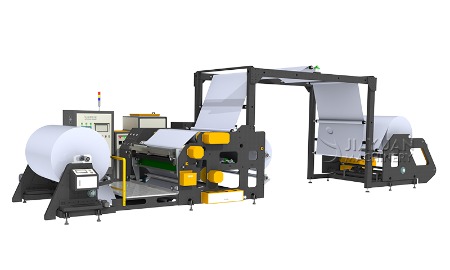
Adhesive coating machine
Surface tension and wetting are critical for coating quality. Water-based adhesives have higher surface tension (~50 mN/m) than solvent-based (~25 mN/m), making them harder to wet on low-energy substrates like polyolefins. Therefore, corona or flame treatment is almost mandatory. The coating bead stability depends on the dynamic surface tension; if it is too high, the bead may break, causing streaks. Surfactants are added to lower surface tension, but excessive foam can result—hence defoamers are needed. The defoamer choice must be compatible; silicone-based defoamers can cause fish-eyes. The machine's die lip geometry and vacuum assist must be tuned to the specific surface tension. Operators should measure the contact angle of the adhesive on the substrate and adjust treatment level accordingly. If wetting is poor, the adhesive may de-wet, leaving bare spots—a catastrophic defect.
Coating quality parameters for water-based adhesives include thickness uniformity, clarity, adhesion, and water resistance. Clarity is affected by incomplete coalescence or the presence of large particles; filtration and uniform drying are key. Adhesion is measured by peel tests; if adhesion is low, it may be due to insufficient wetting, low coat weight, or under-curing. Some formulations include crosslinkers that activate at higher temperatures (e.g., 120°C) to improve cohesion and heat resistance; the oven must achieve this temperature for a sufficient dwell time. Water resistance is tested by immersion; if the adhesive swells or dissolves, it indicates incomplete crosslinking or residual emulsifiers. The machine's ability to maintain consistent web temperature across the width is crucial; temperature profiles should be verified with a thermal imaging camera.
Operational practices also affect quality. The adhesive tank should be agitated gently to maintain homogeneity; sedimentation of heavy fillers can change solid content over time. The tank level should be kept above a minimum to avoid pump cavitation. The filter cartridges must be replaced when differential pressure exceeds 2 bar; clogged filters cause flow fluctuations. The coating die should be cleaned at the end of each shift using a dedicated cleaning solution that dissolves dried polymer without damaging the metal. For water-based systems, water-based cleaners are preferred over aggressive solvents to avoid environmental issues. Additionally, the machine's HMI should display trend charts of coat weight, oven zone temperatures, and humidity; any drift triggers an alarm. Operators should have a quick-reference guide for troubleshooting common issues like orange peel (caused by too high viscosity or low temperature) or cratering (defoamer incompatibility). By thoroughly understanding formulation-machine interactions, operators can maximize the performance of water-based adhesive coating machines, producing sustainable products that meet market demands for safety and performance.