Web Tension Control: Principles, Sensors, and Actuators for Coating Lines
Web tension is defined as the force (in Newtons) applied to the substrate, typically expressed as tension per unit width (N/cm). It must be high enough to keep the web taut and prevent wrinkles, but low enough to avoid stretching or tearing the substrate. The ideal tension depends on the substrate's material, thickness, and width, as well as the line speed. For thin films (e.g., 12 µm PET), the tension may be as low as 0.5 N/cm; for thick paper, it may be 5-10 N/cm. The tension is controlled by adjusting the torque of driven rollers (pull rolls) or the braking torque on unwinding rolls. In a typical coating line, the web passes through several tension zones: the unwinding zone, the coating zone, the drying/curing zone, and the rewinding zone. Each zone may have a different tension setpoint to suit the process. For example, the coating zone requires a stable, low tension to avoid stretching the web during coating; the rewinding zone requires a higher, progressively increasing tension to build a tight roll. The tension in each zone is measured by sensors and controlled by actuators. The control system maintains the setpoints using a cascade of speed and torque loops. Proper tension control is vital for maintaining coat weight uniformity; if the tension fluctuates, the web speed changes slightly, which affects the coat weight (since coat weight = flow rate / speed). Also, high tension can stretch the substrate, reducing its width and changing the coating's effective coverage. Therefore, tension control is a key element of coating line design.
Tension sensors come in several types. Load cells are the most common; they measure the force exerted by the web on an idler roll, typically through strain gauges. Load cells provide a highly accurate, analog signal proportional to the tension. They are installed on a roll that is free to move slightly; the sum of the force components gives the tension. Load cells are reliable but require careful calibration and compensation for the roll's weight. Dancer rolls are another type; they consist of a moving roller that is spring-loaded or air-loaded. The dancer's position is proportional to the tension; a potentiometer or encoder measures the position. Dancer rolls are often used in combination with load cells to provide a mechanical buffer for tension variations. They are simple and robust but have slower response than load cells. Torque sensors measure the torque on a driven roll; with the roll radius known, the tension can be calculated. This method is indirect and less accurate, but it is used in some older systems. In modern lines, load cells are the preferred choice for their accuracy and fast response. The sensor signal is fed to the PLC, which compares it to the setpoint and adjusts the actuator. The control loop is typically a PID controller; the gain must be tuned to avoid overshoot. For high-speed lines, a feedforward signal based on the line speed is used to pre-adjust the torque before the tension sensor detects a change, improving response time.
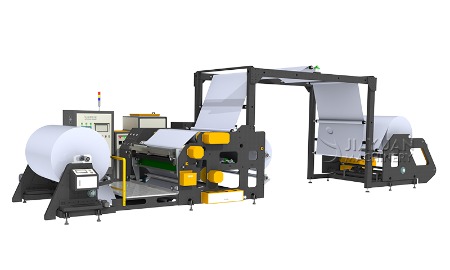
Adhesive coating machine
Actuators for tension control include brakes, clutches, and driven rollers. Brakes are used on the unwinding shaft to provide a braking force that maintains the required back tension. The brake torque is controlled by an electric or pneumatic signal. As the roll diameter decreases, the torque must be reduced to keep the tension constant; this is done by a diameter calculation that divides the torque by the radius. Clutches are similar but used for rewinding. Driven rollers, such as pull rolls, are used to control the web speed and tension in specific zones. They are driven by servo motors or AC motors with VFDs. The motor torque is controlled to maintain the tension setpoint. In a typical arrangement, the main pull roll sets the line speed, while other driven rolls are torque-controlled to maintain the tension gradient. The unwinder is often torque-controlled to provide back tension, while the rewinder is torque-controlled to provide winding tension. The coordination of these actuators is done by the line's control system. The tension setpoints for each zone are stored in the product recipe. During startup, the tension is ramped up gradually; during shutdown, it is ramped down to avoid web slackness. The control system also includes safety limits: if the tension exceeds a maximum, the line stops to prevent web break.
Tension-related defects are common if control is poor. "Wrinkling" occurs when the tension is too low, allowing the web to buckle; increasing tension or adding a spreader roll solves it. "Stretching" occurs when tension is too high, causing permanent deformation; this is corrected by reducing tension or using a stronger substrate. "Web breaks" are often due to a sudden tension spike, usually from a splice or a motor glitch; the control system must have fast response to reject such disturbances. "Coat weight variation" can occur if tension fluctuations cause speed variations; the control system's speed loop must be tight. "Edge curl" is a tendency for the web edges to lift due to differential tension; using edge guides and proper roller alignment helps. The tension profile across the width should be uniform; if the roll is not perfectly cylindrical, the tension varies across the width, leading to coating thickness variations. Therefore, the rolls must be crowned or have a precise profile. In summary,
web tension control is a critical but often undervalued aspect of coating line operation. With proper sensors, actuators, and control algorithms, the web can be transported smoothly and consistently, enabling high-quality coating at high speeds.