Web Tension: Impact on Coating Uniformity, Substrate Strain, and Winding Quality
The substrate in a coating line is under tension, which induces strain (elongation) according to Hooke's law: strain = tension / (elastic modulus × thickness). For a given tension, the strain is higher for thinner or more compliant substrates. For example, a 12 µm PET film with an elastic modulus of 4 GPa under 1 N/cm tension experiences a strain of 0.025%, which is negligible. But for a 50 µm polyurethane film (modulus 0.5 GPa), the same tension gives 0.2% strain, which is significant. This strain changes the web's length and width: the length increases, and the width decreases (Poisson effect). If the tension fluctuates, the web's dimensions fluctuate, which can cause coat weight variations because the coating is applied per unit area; a stretched web has a larger area per unit length, so the same flow rate gives a lower coat weight. Therefore, the tension must be stabilized to maintain a constant coat weight. In addition, the strain can affect the drying process; if the web shrinks during drying, the tension can cause residual stress. The tension should be set such that the web is taut but the strain is within the elastic limit. The elastic limit is typically 0.5-1% for most films; exceeding this causes permanent deformation. The tension setpoint is often chosen based on the substrate manufacturer's recommendation, or determined by a "tension test" where the web is gradually loaded until it yields, and the tension is set to 10-20% of the yield force.
Tension also affects the coating's uniformity across the width. If the tension is uneven across the width (e.g., due to roll misalignment), the web will stretch more on one side, causing the coating to be thinner on that side. This is a common source of transverse thickness variation. To ensure uniform tension across the width, the rolls must be parallel, the nip pressures uniform, and the web guide centered. Using a spreader roll (a curved roll that spreads the web outward) can help to maintain a flat, uniform tension profile. The tension profile can be measured by a multi-zone load cell array or by a web profiling system. If the profile is uneven, the operator can adjust the roll alignment or the nip pressure. The drying oven also imposes tension; as the coating dries, the web may shrink, increasing the tension if the drive rolls are speed-controlled. To prevent this, the oven section often has a separate tension control zone with a dancer roll that allows the web to shrink without increasing tension. This is known as "low-tension drying." In some lines, the web is supported by air flotation to minimize contact and tension variations. The cooling section after the oven also needs tension control, as the web may expand or contract. Thus, the entire line must be designed with tension zones that are independent and adjustable.
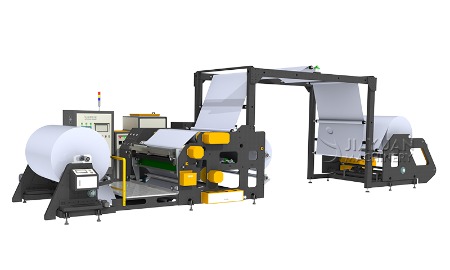
Adhesive coating machine
Winding quality at the rewinder is critically dependent on tension. The winding tension must be controlled to produce a roll that is tight enough to prevent telescoping (layers shifting sideways) but not so tight that it causes crushing or blocking (adhesive sticking to the backside). For adhesive-coated webs, the winding tension must be lower than for non-adhesive webs to prevent the adhesive from squeezing out. The tension is often profiled: it starts low and increases as the roll diameter grows, to maintain a constant internal pressure. This is done by a taper tension program: tension = setpoint × (1 - taper × (D - D_min) / (D_max - D_min)). The taper factor is typically 10-30%. The rewinder's drive torque is calculated based on the roll diameter and the desired tension. The roll diameter is measured by an ultrasonic sensor or calculated from the line speed and the roll's rotational speed. The winding tension must also be coordinated with the upstream tension; if the rewinder pulls too hard, it can drag the web and affect the coating zone. Therefore, a tension isolation zone is often used, where a dancer roll absorbs the tension difference. The quality of the wound roll is checked by measuring its hardness or by visual inspection; if the roll is too soft, it may deform during storage; if too hard, it may cause blocking. In summary,
web tension is a multi-zone variable that must be carefully managed from unwinding to rewinding. Its impact on coating uniformity, substrate integrity, and winding quality is profound. By understanding the substrate's mechanical properties and the dynamics of each zone, operators can set tensions that ensure smooth, defect-free production and a high-quality finished roll.