Wet Coat Thickness: Impact on Leveling, Defect Formation, and Coating Window
Leveling is the process by which a wet coating film flows to eliminate surface irregularities caused by the application method. The driving force is surface tension, which tends to minimize the surface area, while the resistance is the fluid's viscosity. The leveling time is proportional to the fourth power of the wet thickness and inversely proportional to the surface tension. This means that a thicker wet film levels much faster than a thinner one. For example, doubling the thickness reduces the leveling time by a factor of 16. Therefore, to achieve a smooth surface (no orange peel), a certain minimum wet thickness is required, depending on the fluid's viscosity and surface tension. If the wet thickness is too low, the film cannot level before it is dried, resulting in a rough, wavy surface. This is a common problem in low coat weight applications. To overcome this, operators can increase the fluid temperature (lower viscosity) or add a leveling agent (which reduces surface tension), but these changes may affect other properties. Alternatively, the coating method can be adjusted to reduce the initial roughness: slot-die coating generally produces a smoother initial surface than gravure or roll coating, because the flow is more uniform. The wet thickness also affects the formation of "ribbing"—periodic transverse ridges caused by the instability of the coating bead. Ribbing occurs when the wet thickness exceeds a critical value relative to the bead gap; the instability is driven by the pressure gradient. Therefore, a thinner wet coating is more stable against ribbing. There is a trade-off: a thick enough wet layer to level well, but thin enough to avoid ribbing. The optimal wet thickness lies within a "leveling window" that must be found experimentally.
Defect formation is strongly linked to wet coat thickness. "Sagging" (vertical flow in the coating) occurs when the wet thickness is so large that gravity overcomes surface tension and viscosity, causing the liquid to run down the substrate. This is more common in vertical coating lines or on inclined surfaces. To prevent sagging, the wet thickness must be below a critical value, which is a function of the fluid's density, viscosity, and surface tension, and the substrate's angle. In horizontal web coating, sagging is less of an issue, but it can occur at the edges if the edge bead is thick. "Pinholes" and "blisters" are more frequent with thicker wet films because there is more solvent to evaporate, and the solvent has to travel a longer path to the surface. If the solvent evaporates too quickly from the surface, the subsurface solvent can form bubbles that burst, leaving pinholes. A slower drying ramp or a lower initial temperature helps. "Craters" are caused by surface tension gradients (Marangoni effect) that create flow from low-surface-tension areas to high-surface-tension areas; this is more pronounced in thin films where the surface tension effects dominate. In thick films, the bulk viscosity dampens these flows. Thus, the wet thickness affects the type of defects; a thicker film may eliminate certain defects but introduce others. The process engineer must balance these effects by selecting the wet thickness that minimizes the overall defect density. This is usually done by a series of trial runs at different wet thicknesses, followed by defect inspection and quality testing. The defect rate can be plotted against wet thickness to find the optimum.
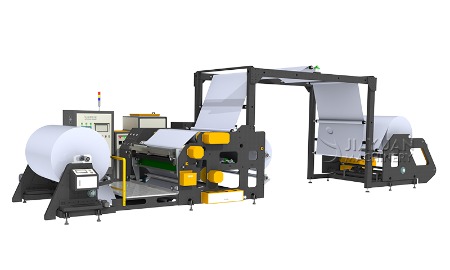
Adhesive coating machine
The coating window—the range of speeds and flow rates that yield a stable coating—is also influenced by the wet thickness. In slot-die coating, the wet thickness is the flow rate per unit width divided by the speed. The coating window is bounded by low-flow breakup, high-flow dripping, air entrainment, and hydrodynamic instability. The wet thickness is a key parameter; for a given fluid and die gap, there is a minimum wet thickness below which the bead breaks, and a maximum above which dripping occurs. This window is narrower for thinner wet coatings because the bead is more fragile. For high-speed operation, the wet thickness must be increased to keep the bead stable, but that increases drying load. Therefore, there is an optimal wet thickness that maximizes the speed while maintaining stability and drying capacity. The window can be extended by adjusting the vacuum, the die angle, or the die gap. A larger die gap allows a wider range of wet thicknesses but may reduce uniformity. The use of surfactants or rheology modifiers can also broaden the window by changing the surface tension or elasticity. The coating window is often plotted as a "speed vs. wet thickness" diagram, with the stability region marked. Operators must keep the operating point within this region. If the line speed changes, the wet thickness will change unless the pump flow is adjusted proportionally. Therefore, the control system must maintain the wet thickness at a constant value by adjusting the pump speed in response to speed changes. This is a critical function of the feedforward control.
Practical strategies for optimizing
wet coat thickness include: (1) Determine the minimum wet thickness for acceptable leveling by running a series of coat weights and measuring the surface roughness; (2) Determine the maximum wet thickness that does not cause sagging or excessive drying defects; (3) Operate at a wet thickness that is comfortably within this range, with a safety margin; (4) Use additives to broaden the leveling and stability windows; (5) If the coating window is narrow, consider changing to a different coating method (e.g., from gravure to slot-die) that offers a wider window; (6) Use a multi-zone drying profile that can handle a range of wet thicknesses; (7) For products with multiple layers, coordinate the wet thickness of each layer to minimize interactions; (8) Regularly check the wet thickness gauge for calibration and clean the sensor window. By following these guidelines, coating lines can achieve a robust process that produces smooth, defect-free coatings with minimal waste. The wet coat thickness is thus a key lever for process optimization, and its proper management is a hallmark of skilled coating engineering. In conclusion, while dry coat weight is the final goal, the wet coat thickness is the intermediate variable that determines how well the coating can be applied and dried. Understanding its effects on leveling, defects, and the coating window enables engineers to design a robust and efficient coating process, delivering high-quality products consistently.