Wet Coat Thickness: Measurement, Control, and Drying Implications
Wet coat thickness is the physical dimension of the liquid layer on the substrate before solvent evaporation. It is typically expressed in micrometers (µm) and is related to the dry coat weight by: wet thickness = dry coat weight / (density of wet fluid × solids fraction). For example, a dry weight of 20 gsm with a wet fluid density of 1.1 g/cm³ and 40% solids gives a wet thickness of 20 / (1.1 × 0.4) = 45.5 µm. Wet thickness is important because it determines the hydrodynamic conditions in the coating bead, the shear rates, and the leveling behavior. It also affects the drying rate; a thicker wet film requires more time to dry and is more prone to defects such as solvent popping and blistering. Therefore, controlling the wet thickness is essential for both coating quality and drying efficiency. In slot-die and gravure coating, the wet thickness is pre-metered; it is set by the pump flow rate and line speed. In roll coating, it is set by the metering gap and the speed ratio. The wet thickness is measured online by optical sensors (laser triangulation, white light interferometry) or by beta gauges that measure the wet weight (if the fluid density is known). Optical sensors are preferred for wet measurement because they are non-contact and provide high resolution (down to 0.1 µm). They are mounted immediately after the coating head, before the oven, to capture the wet film.
The control of wet coat thickness is typically integrated with the dry coat weight control. Since dry weight = wet thickness × wet density × solids fraction, a change in wet thickness will change the dry weight if the solids fraction is constant. Therefore, the control system must regulate the wet thickness to achieve the target dry weight. In practice, the pump flow rate is the primary actuator; the line speed is also a variable. The wet thickness is measured and fed back to the controller, which adjusts the pump speed. However, the wet thickness measurement is often noisier than the dry weight measurement because the liquid surface is unstable and there may be meniscus effects. Therefore, the control loop may use a combination of wet thickness and dry weight (after the oven) to achieve robust control. The wet thickness setpoint is calculated from the desired dry weight and the current solids fraction and density. If the solids fraction changes, the wet setpoint must be recalculated. This is done automatically by the control system using the online solids sensor. The wet thickness measurement also provides early warning of any coating head malfunction; for example, a sudden drop in wet thickness indicates a pump or filter issue, allowing the operator to intervene before a large amount of off-spec dry product is produced.
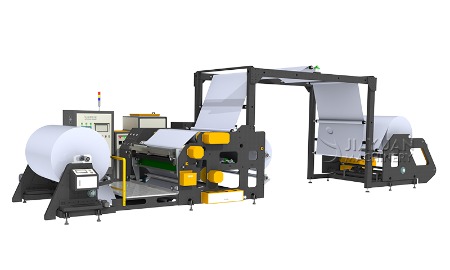
Adhesive coating machine
The drying process is heavily influenced by the wet coat thickness. For a given drying oven, the maximum achievable speed is inversely proportional to the wet thickness because the amount of solvent to evaporate per unit area increases linearly with thickness. A 50% increase in wet thickness roughly doubles the drying time, unless the oven temperature is increased. However, increasing temperature can cause skin formation or substrate damage. Therefore, for thick wet coatings, the line speed must be reduced, or a longer oven is needed. The drying profile should be optimized based on the wet thickness: a gentle initial zone to allow surface evaporation without forming a skin, followed by a high-temperature zone for bulk evaporation. The wet thickness also affects the shrinkage stress during drying; thicker films shrink more, which can cause curling or cracking. Thus, the wet thickness should be kept as low as possible, consistent with the dry weight target and the required solids fraction. Using a higher solids content fluid reduces the wet thickness for the same dry weight, improving drying efficiency and reducing stress. This is why high-solids coatings are preferred, provided they are coatable. The wet thickness also affects the leveling; a thicker wet film has more time to level out surface irregularities, but it also is more prone to orange peel if the viscosity is too high. Therefore, the optimal wet thickness is a compromise between coatability, drying, and leveling.
Measurement of wet thickness in the wet state is challenging because the surface is liquid and reflective. Optical sensors are the most common: a laser triangulation sensor projects a beam onto the coating, and the reflected spot is captured by a camera; the position of the spot shifts with the distance. The sensor measures the distance to the liquid surface; a reference measurement is made on the substrate before coating. The difference gives the wet thickness. The sensor must be mounted at a fixed distance from the web and with a fast enough sampling rate to capture the web's movement. The measurement accuracy is affected by the liquid's refractive index, surface tension, and any ripples. To reduce noise, the measurement is typically averaged over several data points. Another method is using a beta gauge over the wet web; the difference between the wet and dry gauge readings (after the oven) gives the solvent weight, which can be converted to wet thickness if the density is known. This is a less direct method but is more robust because it uses the same gauge for dry measurement. The choice of method depends on the line's configuration and the accuracy required. For high-precision applications, an optical sensor is usually preferred for its fast response and high resolution. The sensor should be calibrated using a set of known wet thickness samples, which are prepared by applying the fluid on a flat plate and measuring the thickness with a mechanical gauge.
Practical guidelines for
wet coat thickness management include: (1) Set the wet thickness target based on the dry weight target and the current solids fraction; (2) Monitor the wet thickness continuously and use it in the control loop; (3) Ensure that the wet thickness measurement is free from optical interference (e.g., from dust or reflections); (4) Compare the wet thickness with the calculated dry weight after drying to verify the solids fraction; (5) If a deviation is observed, check the fluid density and solids content; (6) Adjust the pump speed or die gap to correct any wet thickness drift; (7) When changing products, update the wet thickness setpoint accordingly; (8) Document the wet thickness values in the production log for traceability. By maintaining a stable wet coat thickness, the coating line ensures consistent drying, reduces energy consumption, and minimizes defects related to drying stress. The wet thickness also serves as a sensitive indicator of the coating head's health; a gradual decrease may indicate die wear, while an increase may indicate a clogged filter. Thus, wet thickness monitoring is a valuable diagnostic tool. In summary, wet coat thickness is a critical process parameter that bridges the gap between the coating application and the final dry product. Its precise measurement and control are essential for achieving the desired dry coat weight, optimizing drying, and ensuring product quality. With modern optical sensors and advanced control, wet thickness can be maintained within ±2%, contributing to overall process excellence.